MinuteRead
30 min
Book summary
Premium summary · Opens in the app · 30 min read
Every few decades, a technology arrives that does not simply improve how we work but fundamentally changes what work means. The printing press did this. The assembly line did this. The internet did this. Generative AI is doing this right now.
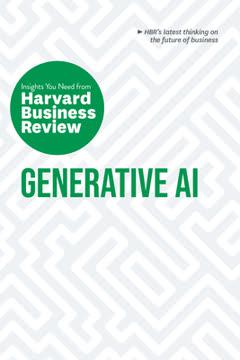
**Author:** Harvard Business Review
**Estimated Reading Time:** 42 minutes
**What You'll Learn:**
- Why generative AI represents a fundamental shift in how businesses interact with customers - How data network effects create compounding advantages for AI-powered companies - A practical framework for selecting AI projects with the right balance of risk and reward - How generative AI transforms creative work, sales, and problem-solving - The intellectual property and ethical challenges that demand immediate attention - A systematic approach to responsible AI integration
**Who This Book Is For:**
Business leaders evaluating where generative AI fits into their strategy. Managers responsible for implementing AI initiatives. Creative professionals navigating a rapidly shifting landscape. Sales leaders wondering how AI will reshape their teams. Anyone who wants to understand generative AI beyond the hype and apply it with clarity and confidence.
Every few decades, a technology arrives that does not simply improve how we work but fundamentally changes what work means. The printing press did this. The assembly line did this. The internet did this. Generative AI is doing this right now. The difference this time is speed. Previous technological revolutions unfolded over decades, giving organizations time to adapt. Generative AI has moved from research curiosity to boardroom priority in less than five years. Companies that hesitated to adopt cloud computing had years to catch up. Companies that hesitate on generative AI may find themselves permanently behind. The challenge is not awareness. Most business leaders now recognize that generative AI matters. The challenge is understanding. What exactly does this technology do? Where does it create genuine value? Where does it introduce unacceptable risk? How should an organization think about integrating it into products, processes, and customer relationships? This book addresses those questions directly. It brings together the most rigorous thinking from Harvard Business Review on generative AI, distilling insights from researchers, practitioners, and executives who are actively building with this technology. The goal is not to predict the future but to provide a practical framework for navigating it. The central insight is deceptively simple: generative AI changes the nature of how we interact with all software. For decades, software has been a tool we operate. We click buttons, navigate menus, and fill out forms. Generative AI transforms software into something we converse with. It understands our intent, generates original content, and adapts to our needs in real time. This shift from tool to collaborator has profound implications for every industry. Consider what this means for customer experience. A traditional banking app requires users to learn its interface. They must know where to find their balance, how to transfer funds, how to dispute a charge. A generative AI-powered banking experience is different. The customer simply says…
Continue reading in the MinuteRead app
Get the complete 30-minute summary of Generative AI
Get the complete summary in the appGenerative AI transforms software from a tool into a collaborator.
Data network effects create compounding advantages for early movers.
Start AI projects in low-risk, high-demand areas.
Generative AI augments human creativity rather than replacing it.
Problem formulation matters more than prompt engineering.
Intellectual property risks require proactive management.
"Generative AI" is a strong fit if you want practical ideas around artificial intelligence, business, technology, especially themes like generative ai transforms software from a tool into a collaborator; data network effects create compounding advantages for early movers. The MinuteRead summary distills these concepts into a focused read, whether you're deciding whether to buy the book or applying its lessons at work.
Harvard Business Review is a general management magazine published by Harvard Business Publishing, a wholly-owned subsidiary of Harvard University. It was first published in 1922 and is headquartered in Brighton, Massachusetts. The magazine focuses on various aspects of business management and strategy, offering insights from academics, business executives, and management experts. HBR is known for its case studies, research articles, and practical advice for business leaders. The publication has…
View all summaries by Harvard Business ReviewContinue Reading
Access the complete 30-minute summary and thousands more nonfiction books in the MinuteRead app.

Continue reading the complete summary in the MinuteRead app.