MinuteRead
30 min
Book summary
Premium summary · Opens in the app · 30 min read
For most of human history, the boundaries of knowledge expanded at the pace of human courage. Explorers crossed oceans. Scientists peered through telescopes. Philosophers pushed the edges of thought. Every discovery, every leap forward, was constrained by the limits of a single human mind and a single human lifetime. The story of civilization is, in many ways, the story of individuals struggling against those limits.
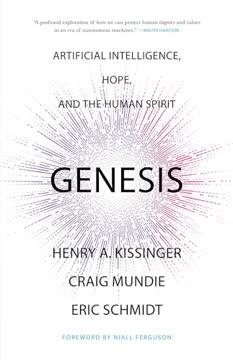
**Author:** Henry Kissinger (with Eric Schmidt and Craig Mundie)
**Estimated Reading Time:** 45 minutes
**What You'll Learn:** How artificial intelligence is reshaping human identity, political power, scientific discovery, and global order, and why humanity must urgently develop new frameworks for coexistence with intelligent machines.
**Who This Book Is For:** Anyone seeking to understand the deeper philosophical and strategic implications of AI beyond the technical headlines. This is not a book about algorithms or coding. It is a book about power, meaning, and what it will mean to be human in an age when intelligence is no longer exclusively ours.
For most of human history, the boundaries of knowledge expanded at the pace of human courage. Explorers crossed oceans. Scientists peered through telescopes. Philosophers pushed the edges of thought. Every discovery, every leap forward, was constrained by the limits of a single human mind and a single human lifetime. The story of civilization is, in many ways, the story of individuals struggling against those limits. That story is now changing. For the first time, humanity has created something that may exceed its own cognitive boundaries. Artificial intelligence does not simply calculate faster than we do. It learns differently. It perceives patterns we cannot see. It operates on timescales that compress decades of human intellectual labor into days, hours, or moments. This is not merely a new tool. It is a new kind of intelligence entering the world. Henry Kissinger spent his life thinking about power: how it is acquired, how it is exercised, how it shapes nations and individuals. In his final book, written with technologists Eric Schmidt and Craig Mundie, he turns his attention to a force that may prove more transformative than any political revolution or military conflict. The rise of AI, he argues, is not primarily a technological event. It is a philosophical one. It forces us to ask questions that have never been practical before: What is intelligence? What is consciousness? What makes human beings worthy of dignity and respect? What happens to political order when decision-making can be delegated to machines that think in ways we do not fully understand? These questions are no longer speculative. AI systems already influence what we read, what we buy, how diseases are diagnosed, and how wars are fought. They are embedded in the infrastructure of daily life. Yet most people, including many of the people making decisions about AI, have not thought deeply about where this path leads. The technology is advancing faster than our ability to understand it, and far faster than our ability to govern it. The central challenge Kissinger identifies is not whether AI will be powerful. It will be. The challenge is whether humanity can…
Continue reading in the MinuteRead app
Get the complete 30-minute summary of Genesis
Get the complete summary in the appAI is not just another tool. It is a new kind of intelligence that can make decisions, generate insights, and pursue obj
AI thinks differently than humans do. It is not simply faster or more powerful. It operates on fundamentally different p
The opacity of AI systems creates challenges for trust and accountability. We may not understand how AI arrives at its c
AI will transform political power. The concentration of AI capabilities could undermine democracy and enable authoritari
Existing ethical frameworks are inadequate for AI. We need new ways of thinking about agency, responsibility, and dignit
The benefits of AI will not be distributed equally by default. Deliberate policy is needed to ensure broad access.
"Genesis" is a strong fit if you want practical ideas around artificial intelligence, science, technology, especially themes like ai is not just another tool. it is a new kind of intelligence that can make decisions, generate insights, and pursue obj; ai thinks differently than humans do. it is not simply faster or more powerful. it operates on fundamentally different p. The MinuteRead summary distills these concepts into a focused read, whether you're deciding whether to buy the book or applying its lessons at work.
Henry A. Kissinger , co-author of Genesis, was a renowned American diplomat, political scientist, and statesman. He served as United States Secretary of State and National Security Advisor under Presidents Richard Nixon and Gerald Ford. Kissinger played a significant role in shaping U.S. foreign policy during the Cold War era, including the policy of détente with the Soviet Union and opening relations with China. He was awarded the Nobel Peace Prize in 1973 for his efforts to negotiate a ceasefi…
View all summaries by Henry KissingerContinue Reading
Access the complete 30-minute summary and thousands more nonfiction books in the MinuteRead app.

Continue reading the complete summary in the MinuteRead app.