MinuteRead
30 min
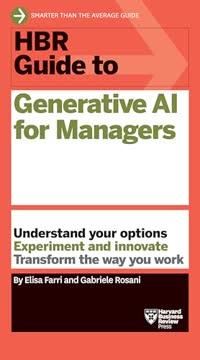
Book summary
by Elisa Farri
Premium summary · Opens in the app · 30 min read
For most of modern history, the relationship between managers and machines followed a predictable pattern. Machines handled the repetitive work. They processed transactions, sorted data, and executed commands with speed and precision. But when it came to thinking, creating, and deciding, humans remained firmly in charge.
**Author:** Elisa Farri
**Estimated Reading Time:** 45 minutes
**What You'll Learn:**
- How generative AI fundamentally changes the relationship between managers and machines - Two distinct modes of working with AI: Co-Pilot for execution and Co-Thinker for strategy - Practical methods for using AI to enhance personal productivity, communication, and leadership - Frameworks for applying AI to team operations, decision-making, and organizational change - How to avoid the hidden traps of over-reliance on AI-generated output
**Who This Book Is For:**
This book is for managers who want to move beyond the hype surrounding generative AI and understand how to use it as a genuine partner in their daily work. Whether you are new to these tools or already experimenting with them, this guide offers a structured approach to integrating AI into your management practice without losing the human judgment that defines effective leadership.
For most of modern history, the relationship between managers and machines followed a predictable pattern. Machines handled the repetitive work. They processed transactions, sorted data, and executed commands with speed and precision. But when it came to thinking, creating, and deciding, humans remained firmly in charge. That boundary has now dissolved. In November 2022, OpenAI released ChatGPT to the public, and within weeks, millions of people discovered something remarkable: they could hold genuine conversations with a machine. They could ask it to draft a memo, brainstorm marketing ideas, analyze a spreadsheet, or role-play a difficult conversation with an employee. The machine responded not with links or commands, but with coherent, thoughtful, and often surprisingly insightful language. This was not another incremental improvement in software. It was a category shift. The implications for managers are profound. For decades, management has been defined by the ability to process information, make decisions, and communicate effectively. Now, a new kind of partner can assist with all three. The question is no longer whether generative AI will affect management. The question is whether managers will learn to use it effectively or find themselves outpaced by those who do. Yet most managers remain uncertain about how to proceed. They experiment with AI tools casually, asking for the occasional email draft or meeting summary. They sense the potential but lack a framework for integrating AI into their broader responsibilities. They worry about accuracy, about looking foolish, about relying too heavily on a technology they do not fully understand. This book addresses those concerns directly. It offers a practical guide to working with generative AI as a manager, not as a technologist. It explains how to shift from treating AI as a novelty to treating it as a genuine collaborator. It provides concrete methods for using AI to improve personal productivity, sharpen strategic thinking, lead…
Continue reading in the MinuteRead app
Get the complete 30-minute summary of HBR Guide to Generative AI for Managers
Get the complete summary in the appGenerative AI is a partner, not just a tool. Engage with it as you would a knowledgeable collaborator.
Use Co-Pilot mode for execution tasks and Co-Thinker mode for reflection tasks. Match the mode to the task.
Always verify AI output. AI can be confidently wrong, and the consequences of acting on false information can be severe.
Use AI to challenge your assumptions, not confirm them. Ask for devil's advocate perspectives.
Effective prompting requires precision, context, format specification, and examples. Invest in developing this skill.
The trust trap is real. Maintain active engagement with AI output and never abdicate responsibility to the machine.
"HBR Guide to Generative AI for Managers" is a strong fit if you want practical ideas around artificial intelligence, leadership, business, especially themes like generative ai is a partner, not just a tool. engage with it as you would a knowledgeable collaborator; use co-pilot mode for execution tasks and co-thinker mode for reflection tasks. match the mode to the task. The MinuteRead summary distills these concepts into a focused read, whether you're deciding whether to buy the book or applying its lessons at work.
Elisa Farri is the author of "HBR Guide to Generative AI for Managers," a book that has garnered attention for its practical insights into applying artificial intelligence in business management. Farri's work focuses on helping managers understand and implement AI technologies in their day-to-day operations. Her approach emphasizes using AI as both a productivity enhancer and a strategic tool. While specific biographical information is limited in the provided content, Farri's expertise in the fi…
View all summaries by Elisa FarriContinue Reading
Access the complete 30-minute summary and thousands more nonfiction books in the MinuteRead app.

Continue reading the complete summary in the MinuteRead app.