MinuteRead
30 min
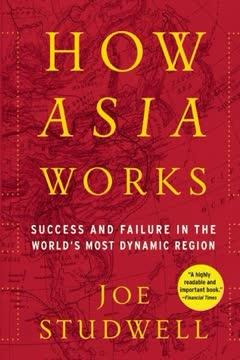
Book summary
by Joe Studwell
Premium summary · Opens in the app · 30 min read
Every few years, a new development miracle captures the world's attention. In the 1960s, it was Japan. In the 1980s, the Asian Tigers. In the 2000s, China. Economists, journalists, and policymakers rush to explain the phenomenon, usually by pointing to some combination of free markets, open trade, and foreign investment. The story is comforting: follow the rules, open your economy, and prosperity will follow.
**Author:** Joe Studwell
**Estimated Reading Time:** 45 minutes
**What You'll Learn:**
- Why land reform and household farming are the essential first step for poor countries - How export discipline transforms domestic manufacturers into global competitors - Why financial systems must serve development goals rather than speculative interests - The critical differences between Northeast Asian success and Southeast Asian struggle - What China's development path reveals about the future of economic growth
**Who This Book Is For:**
This book is for anyone who wants to understand why some countries become wealthy while others remain trapped in poverty. It is for readers curious about the real mechanics of economic development, beyond the slogans of free markets and globalization. It is for entrepreneurs, policymakers, investors, and students who want to see how Japan, South Korea, Taiwan, and China actually built their economies, and why the standard advice from international institutions so often fails.
Every few years, a new development miracle captures the world's attention. In the 1960s, it was Japan. In the 1980s, the Asian Tigers. In the 2000s, China. Economists, journalists, and policymakers rush to explain the phenomenon, usually by pointing to some combination of free markets, open trade, and foreign investment. The story is comforting: follow the rules, open your economy, and prosperity will follow. Joe Studwell spent decades watching this story fall apart. As a journalist and analyst living in East Asia, he observed something that did not fit the standard narrative. The countries that actually developed, the ones that transformed themselves from poor agricultural societies into industrial powerhouses, did not follow the free-market playbook. They did something far more deliberate, far more interventionist, and far more effective. The problem begins with a simple observation. Most poor countries are poor because most of their people work in agriculture. In sub-Saharan Africa, in South Asia, in much of Southeast Asia, sixty to eighty percent of the population labors on small plots of land or works as landless laborers on large estates. They produce barely enough to feed themselves. They have no savings. They cannot buy the goods that factories might produce. An economy built on this foundation cannot grow, no matter how many free-trade agreements are signed. The countries that escaped this trap did something radical. They redistributed land. Japan did it after World War II, under American occupation. South Korea did it in the late 1940s. Taiwan did it in the 1950s. China did it, in its own chaotic way, in the early 1980s. In each case, the result was the same: agricultural output surged, rural incomes rose, and a mass market for manufactured goods emerged for the first time. This was not an accident. It was the first…
Continue reading in the MinuteRead app
Get the complete 30-minute summary of How Asia Works
Get the complete summary in the app**Land reform comes first.** Redistribute land to smallholders. Support them with extension services, credit, and infras
**Household farming produces higher yields.** Small-scale, labor-intensive farming produces more per hectare than large-
**Export discipline transforms firms.** Protect domestic firms from imports, but force them to export. This creates a cl
**Import substitution fails.** Protection without export discipline leads to inefficiency. Domestic firms become complac
**Finance must serve the real economy.** Direct credit toward productive investment. Restrict capital flows. Prevent spe
**Premature liberalization is dangerous.** The risks of premature deregulation are greater than the risks of tardy dereg
"How Asia Works" is a strong fit if you want practical ideas around economics, business, history, especially themes like **land reform comes first.** redistribute land to smallholders. support them with extension services, credit, and infras; **household farming produces higher yields.** small-scale, labor-intensive farming produces more per hectare than large-. The MinuteRead summary distills these concepts into a focused read, whether you're deciding whether to buy the book or applying its lessons at work.
Joe Studwell is a British journalist and author specializing in Asian business, politics, and economic development. He has extensive experience reporting on and analyzing the region, having lived and worked in East Asia for many years. Studwell is known for his in-depth research and critical analysis of economic policies and their impacts. His work challenges conventional wisdom about development economics and offers alternative perspectives on how countries can achieve economic growth. Joe Stud…
View all summaries by Joe StudwellContinue Reading
Access the complete 30-minute summary and thousands more nonfiction books in the MinuteRead app.

Continue reading the complete summary in the MinuteRead app.