MinuteRead
30 min
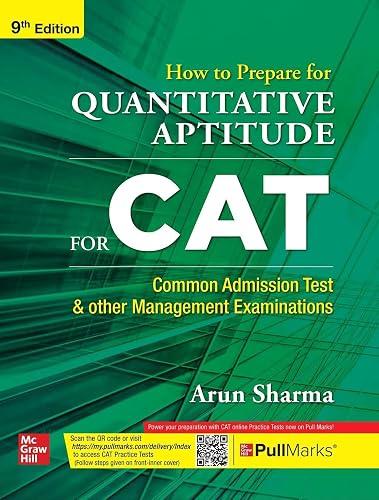
Book summary
by Arun Sharma
Premium summary · Opens in the app · 30 min read
Every year, hundreds of thousands of students sit for the Common Admission Test, hoping to secure a place in India's premier management institutions. Most of them have studied mathematics for years. Most of them can solve problems when given enough time. Yet only a small fraction achieve the scores required for admission to the top schools.
**Author:** Arun Sharma
**Estimated Reading Time:** 45 minutes
**What You'll Learn:**
- Why addition is the single most important skill for quantitative dominance - How to structure your CAT preparation into six strategic blocks - The percentage rule that transforms complex calculations into simple addition - How to develop pre-formed logic for instant pattern recognition - The counting toolbox approach to permutations and probability - A complete 30-day implementation plan for lasting improvement
**Who This Book Is For:**
This condensed edition is for anyone preparing for the CAT or other management entrance examinations who wants to move beyond rote memorization and develop genuine quantitative mastery. Whether you are just beginning your preparation or looking to refine your approach after months of study, the frameworks and mental models in this book will reshape how you think about mathematical problem-solving.
Every year, hundreds of thousands of students sit for the Common Admission Test, hoping to secure a place in India's premier management institutions. Most of them have studied mathematics for years. Most of them can solve problems when given enough time. Yet only a small fraction achieve the scores required for admission to the top schools. Why? The answer lies not in what students know, but in how they access what they know under pressure. The CAT is not a test of mathematical knowledge. It is a test of mathematical readiness. The distinction matters enormously. Consider what happens when you sit down to solve a problem. You read the question. You begin to work through the logic. You perform calculations. You arrive at an answer. This process feels natural, almost automatic. But hidden within it are dozens of micro-decisions that determine whether you finish in two minutes or six minutes. Whether you recognize the pattern immediately or struggle to find a starting point. Whether you trust your answer or second-guess yourself. Arun Sharma's approach to quantitative aptitude rests on a simple but profound insight: the battle for the CAT is won or lost before you ever enter the examination hall. It is won through the quality of pre-formed logic you bring to each question. When you see a problem and immediately think "I know this pattern," you have already solved most of it. The remaining work is execution. This book exists because most students prepare for quantitative aptitude in exactly the wrong way. They study chapters in isolation. They memorize formulas without understanding the underlying relationships. They practice problems without developing the mental structures that allow for rapid recognition. They work hard, but they work without strategy. Sharma's method is different. He begins with the foundation: addition. Not because addition is difficult, but because it is fundamental. Every calculation you perform, from…
Continue reading in the MinuteRead app
Get the complete 30-minute summary of How to Prepare for Quantitative Aptitude for the CAT Common Admission Test
Get the complete summary in the appPractice addition daily until it becomes automatic. Addition is the foundation of all calculation.
Organize your study into six blocks: Number Systems, Averages, Arithmetic, Geometry, Algebra, and Counting.
Use the percentage rule to calculate percentages through addition rather than division.
Develop visualization skills for geometry. Draw figures from verbal descriptions until you can see them in your mind.
Connect algebraic expressions to their graphical representations. Visualize inequalities rather than testing intervals.
Treat counting as a language translation problem. "AND" means multiply, "OR" means add.
"How to Prepare for Quantitative Aptitude for the CAT Common Admission Test" is a strong fit if you want practical ideas around education, mathematics, business, especially themes like practice addition daily until it becomes automatic. addition is the foundation of all calculation; organize your study into six blocks: number systems, averages, arithmetic, geometry, algebra, and counting. The MinuteRead summary distills these concepts into a focused read, whether you're deciding whether to buy the book or applying its lessons at work.
Motivated to help readers with addition being the mother of all calculations has the potential of giving you the extra edge you require to, Arun Sharma wrote “How to Prepare for Quantitative Aptitude for the CAT Common Admission Test” to package those ideas for a fast, focused read. In “How to Prepare for Quantitative Aptitude for the CAT Common Admission Test”, Arun Sharma focuses on addition being the mother of all calculations has the potential of giving you the extra edge you require to. Thr…
Continue Reading
Access the complete 30-minute summary and thousands more nonfiction books in the MinuteRead app.

Continue reading the complete summary in the MinuteRead app.