MinuteRead
30 min
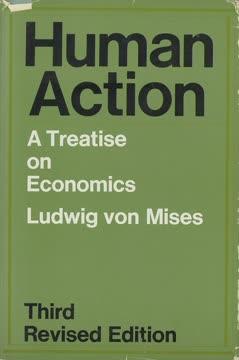
Every day you make thousands of choices. You decide when to wake, what to eat, which tasks to pursue, which conversations to have, and which paths to avoid. Most of these choices happen so quickly and so quietly that you barely notice them. Yet beneath each one lies a profound truth about what it means to be human.
**Author:** Ludwig von Mises
**Estimated Reading Time:** 45 minutes
**What You'll Learn:**
- Why every human action is purposeful and what this reveals about the nature of choice - How economics emerged as the science of human decision-making under scarcity - Why the division of labor is the foundation of all civilization - How uncertainty shapes every decision you will ever make - Why economic calculation is essential for a functioning society - How voluntary cooperation creates complex social order without central planning - What freedom truly requires and why reason is humanity's defining gift
**Who This Book Is For:**
This book is for anyone who wants to understand the deep logic beneath everyday choices. It is for readers who sense that economics is not merely about money but about the very structure of human life. It is for those who want to grasp why societies prosper or collapse, why cooperation emerges without commands, and why freedom and reason are inseparable. If you have ever wondered what makes human beings fundamentally different from all other creatures, this book will give you an answer that stays with you for life.
Every day you make thousands of choices. You decide when to wake, what to eat, which tasks to pursue, which conversations to have, and which paths to avoid. Most of these choices happen so quickly and so quietly that you barely notice them. Yet beneath each one lies a profound truth about what it means to be human. Ludwig von Mises wrote *Human Action* to uncover that truth. Published in 1949 after decades of intellectual labor, the book is not a conventional economics text. It is a treatise on the nature of human existence itself. Mises believed that before anyone could understand markets, prices, money, or trade, they first had to understand something more fundamental: the structure of human action. The problem Mises identified was that economics had lost its way. Many economists treated human beings as if they were objects, like stones rolling down hills or chemicals reacting in a laboratory. They built mathematical models that assumed people behaved with mechanical predictability. They searched for constants and formulas that would explain economic life the way physics explains the motion of planets. Mises saw this as a catastrophic error. Human beings are not stones. They are not chemicals. They are conscious agents who choose, plan, hope, fear, and act. Any science that ignores this fact will fail to explain the most important phenomena of social life. The challenge is that human action is deeply complex. Unlike the natural sciences, which study objects that behave according to fixed laws, the sciences of human action must contend with meaning, purpose, and choice. A…
Continue reading in the MinuteRead app
Get the complete 30-minute summary of Human Action
Get the complete summary in the app**Action is purposeful behavior.** Every action aims at a goal and seeks to improve the actor's condition.
**Value is subjective.** Nothing has value in itself. Value exists only in the judgments of individuals.
**The division of labor creates prosperity.** Specialization and exchange benefit everyone.
**The future is uncertain.** Every action is a speculation about an unknown future.
**Prices enable economic calculation.** Without prices, rational resource allocation is impossible.
**Money is not wealth.** Inflation destroys savings and distorts the economy.
"Human Action" is a strong fit if you want practical ideas around economics, philosophy, politics, especially themes like **action is purposeful behavior.** every action aims at a goal and seeks to improve the actor's condition; **value is subjective.** nothing has value in itself. value exists only in the judgments of individuals. The MinuteRead summary distills these concepts into a focused read, whether you're deciding whether to buy the book or applying its lessons at work.
Ludwig Heinrich Edler von Mises was an influential Austrian economist, philosopher, and classical liberal thinker. Born in 1881, he made significant contributions to the Austrian School of Economics and the libertarian movement. Mises' work had a notable impact on Austrian government economic policies in the early 20th century. He authored numerous books and articles, with "Human Action" being his magnum opus. Mises' ideas on free markets, individual liberty, and limited government continue to s…
View all summaries by Ludwig von MisesContinue Reading
Access the complete 30-minute summary and thousands more nonfiction books in the MinuteRead app.

Continue reading the complete summary in the MinuteRead app.