MinuteRead
30 min
In the winter of 1931, a short, impeccably dressed Cambridge don walked into a room at the London School of Economics and proceeded to demolish the intellectual foundations of his opponents. John Maynard Keynes was already famous, a man whose wit and confidence could fill any lecture hall. Across the room sat Friedrich Hayek, a tall, reserved Austrian aristocrat who had recently arrived in England to challenge everything Keynes believed. What followed was not merely a disagreement between two pr
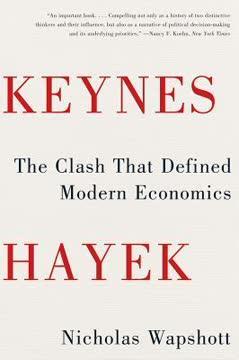
**Author:** Nicholas Wapshott
**Estimated Reading Time:** 2 hours 15 minutes
**What You'll Learn**
You will learn how two brilliant economists, John Maynard Keynes and Friedrich Hayek, developed radically different visions for how economies work and what governments should do about them. You will understand why their debate in the 1930s still matters every time a financial crisis strikes, a government prints money, or a central bank sets interest rates. You will see how their ideas shaped the New Deal, the post-war boom, the Thatcher-Reagan revolution, and the response to the 2008 crash. Most importantly, you will gain the intellectual tools to think clearly about the deepest economic question of all: how much should the state control, and how much should it leave alone?
**Who This Book Is For**
This book is for anyone who has ever wondered why governments spend billions during recessions, why central banks exist, or why some people fear inflation more than unemployment. It is for readers who sense that economics is not just about numbers but about freedom, power, and the kind of society we want to live in. You do not need an economics degree. You need curiosity about the ideas that rule the world.
In the winter of 1931, a short, impeccably dressed Cambridge don walked into a room at the London School of Economics and proceeded to demolish the intellectual foundations of his opponents. John Maynard Keynes was already famous, a man whose wit and confidence could fill any lecture hall. Across the room sat Friedrich Hayek, a tall, reserved Austrian aristocrat who had recently arrived in England to challenge everything Keynes believed. What followed was not merely a disagreement between two professors. It was a collision between two ways of understanding human society. The question they fought over was deceptively simple. When an economy collapses and millions lose their jobs, what should be done? Should the government step in, spend money, hire workers, and try to jump-start the stalled engine? Or should it step back, let prices fall, let bad businesses fail, and wait for the market to heal itself? Keynes said the government must act. Without intervention, he argued, an economy could remain stuck in a depression for years, wasting human lives on a scale that no civilized society should tolerate. Hayek said the opposite. Government intervention, he warned, would only make things worse. It would distort the signals that prices send, misdirect resources, and set the stage for an even bigger crisis later. Worse still, it would put society on a slippery slope toward centralized control and the loss of freedom. The debate was not abstract. It was fought against the backdrop of the Great Depression, when unemployment in Britain…
Continue reading in the MinuteRead app
Get the complete 30-minute summary of Keynes Hayek
Get the complete summary in the appKeynes believed governments should spend during slumps to boost demand. Hayek believed intervention distorts signals and
The Great Depression seemed to prove Keynes right. Stagflation in the 1970s seemed to prove Hayek right. The 2008 crisis
The multiplier effect means government spending can generate more economic activity than it costs, but only when the eco
The knowledge problem means no central planner can gather the information that prices automatically coordinate across mi
The paradox of thrift means that when everyone saves more in a slump, total saving may fall because incomes fall faster.
Keynes was not a socialist. He wanted to save capitalism by correcting its failures. Hayek was not an anarchist. He acce
"Keynes Hayek" is a strong fit if you want practical ideas around economics, history, politics, especially themes like keynes believed governments should spend during slumps to boost demand. hayek believed intervention distorts signals and; the great depression seemed to prove keynes right. stagflation in the 1970s seemed to prove hayek right. the 2008 crisis. The MinuteRead summary distills these concepts into a focused read, whether you're deciding whether to buy the book or applying its lessons at work.
Nicholas Wapshott is a British-born journalist and author based in New York. He has held senior editorial positions at prominent publications such as The Times of London and the New York Sun. Wapshott has written several books on political and economic subjects, including a notable work on the relationship between Ronald Reagan and Margaret Thatcher. His journalistic background influences his writing style, which is often praised for making complex topics accessible to general readers. Wapshott'…
View all summaries by Nicholas WapshottContinue Reading
Access the complete 30-minute summary and thousands more nonfiction books in the MinuteRead app.

Continue reading the complete summary in the MinuteRead app.