MinuteRead
30 min
Book summary
by Nik Bhatia
Premium summary · Opens in the app · 30 min read
Money is the most universal human invention after language. Every person on earth uses it. Every society depends on it. Every government obsesses over it. Yet almost no one can explain what it actually is.
**Author:** Nik Bhatia
**Estimated Reading Time:** 45 minutes
**What You'll Learn:**
- Why money has always been a system of layered promises, not just coins and bills - How central banks captured the most powerful position in the monetary hierarchy - Why the dollar's dominance created unprecedented global financial fragility - How Bitcoin introduces a new form of money that exists outside the traditional pyramid - What a future monetary system built on Bitcoin and layered technologies might look like
**Who This Book Is For:**
This book is for anyone who has ever wondered what money actually is. It is for investors trying to understand Bitcoin beyond price speculation. It is for students of economics who sense that textbook definitions miss something essential. It is for the curious reader who wants to understand why financial crises keep happening despite ever more sophisticated regulation. If you have ever felt that the global financial system is more fragile than it appears, this book will give you the framework to understand why, and the vision to imagine what comes next.
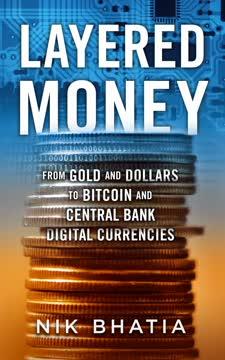
Money is the most universal human invention after language. Every person on earth uses it. Every society depends on it. Every government obsesses over it. Yet almost no one can explain what it actually is. Ask someone to define money and they will likely describe physical currency. Coins. Bills. The stuff in their wallet. But physical currency represents only a tiny fraction of the money that exists in the world today. The vast majority of money is invisible. It exists as digital entries in bank ledgers, as promises between financial institutions, as contracts that derive their value from other contracts. Money is not a thing. Money is a system. Nik Bhatia wrote *Layered Money* to explain this system. His central insight is deceptively simple: money has always existed in layers. At the bottom sits the most solid form of money, the thing that settles all debts without requiring any promise. Above it sit layers of promises, each one deriving its value from the layer below. This structure is not a modern invention. It is not a flaw. It is the natural way money organizes itself in every era and every civilization. The problem is that most people do not see these layers. They see only the surface. They see prices, paychecks, and bank balances. They do not see the pyramid of promises underneath. When the system works, this blindness is harmless. When the system breaks, this blindness becomes catastrophic. The 2008 financial crisis was a moment when the layers became visible. For a few terrifying weeks, the promises that underpinned global finance stopped being trustworthy. Banks refused to lend to each other. Money…
Continue reading in the MinuteRead app
Get the complete 30-minute summary of Layered Money
Get the complete summary in the appMoney is a layered system of promises, not a thing.
First-layer money settles all debts without requiring any promise. Gold was first-layer money. Bitcoin is digital first-
The pivotal position in the monetary system is the junction between first and second layers. Central banks control this
The dollar became the world's reserve currency through Bretton Woods and retained that position even after the gold link
The 2008 crisis revealed the fragility of the dollar pyramid and the Fed's role as its ultimate backstop.
Bitcoin is a digital bearer asset with no counterparty risk and a fixed supply.
"Layered Money" is a strong fit if you want practical ideas around economics, finance, money, especially themes like money is a layered system of promises, not a thing; first-layer money settles all debts without requiring any promise. gold was first-layer money. bitcoin is digital first-. The MinuteRead summary distills these concepts into a focused read, whether you're deciding whether to buy the book or applying its lessons at work.
Nik Bhatia is a financial expert and author known for his work on cryptocurrency and monetary systems. He gained recognition for developing the "layered money" framework, which provides a unique perspective on the structure and evolution of money. Bhatia's background includes experience in fixed income securities trading and risk management. He currently teaches finance and digital currency at the University of Southern California. His writing style is praised for being clear and accessible, mak…
View all summaries by Nik BhatiaContinue Reading
Access the complete 30-minute summary and thousands more nonfiction books in the MinuteRead app.

Continue reading the complete summary in the MinuteRead app.