MinuteRead
30 min
Book summary
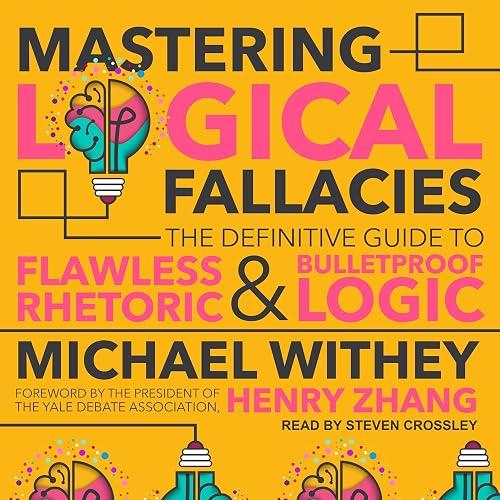
by Michael Withey
Premium summary · Opens in the app · 30 min read
Arguments are everywhere. Turn on your television, scroll through social media, sit through a business meeting, or have dinner with family, and you will encounter people trying to persuade you. Some will present careful reasoning backed by evidence. Many will not. They will rely on emotional manipulation, rhetorical tricks, and logical errors that sound convincing but collapse under scrutiny.
**Author:** Michael Withey
**Estimated Reading Time:** 38 minutes
**What You'll Learn:**
- How to identify the most common logical fallacies in everyday arguments - Why these reasoning errors are so persuasive despite being invalid - Practical strategies for countering flawed arguments in real time - How to strengthen your own reasoning and avoid falling into fallacy traps - The essential skills of logical literacy that apply to politics, media, relationships, and work
**Who This Book Is For:**
Anyone who has ever walked away from an argument feeling frustrated but unable to articulate why the other person's reasoning was flawed. Anyone who wants to think more clearly, communicate more effectively, and resist manipulation in a world saturated with persuasive but logically unsound messages.
Arguments are everywhere. Turn on your television, scroll through social media, sit through a business meeting, or have dinner with family, and you will encounter people trying to persuade you. Some will present careful reasoning backed by evidence. Many will not. They will rely on emotional manipulation, rhetorical tricks, and logical errors that sound convincing but collapse under scrutiny. Michael Withey's book addresses a fundamental problem: most people have never been taught how to evaluate arguments. We learn grammar, arithmetic, and history in school, but we rarely receive formal instruction in the art of reasoning itself. This is a striking gap in our education. Every single person will encounter arguments throughout their lives. Every person will need to make decisions based on claims made by others. Every person will, at some point, be misled by a persuasive but flawed argument. Yet we send people into this world without the basic tools to distinguish sound reasoning from sophistry. The consequences of this gap are serious. People fall for scams. They vote for policies that harm them. They make poor financial decisions. They hold beliefs that are demonstrably false. They get drawn into cults, conspiracy theories, and toxic relationships. They argue badly with the people they love, damaging relationships over disagreements that could have been resolved through clearer thinking. Logical fallacies are the specific errors in reasoning that make arguments invalid. They are patterns of thought that seem persuasive on the surface but fail to actually support their conclusions. The term "fallacy" comes from the Latin word "fallacia," meaning deceit or trick. This etymology is revealing. Fallacies are tricks our minds play on us, and tricks that others play on us, often without either party being fully aware of what is happening. What makes fallacies so dangerous is that they are not always obvious. A well-constructed fallacious argument can feel more persuasive than a sound one. It can appeal to our emotions, our biases, our desire to belong, our fear…
Continue reading in the MinuteRead app
Get the complete 30-minute summary of Mastering Logical Fallacies
Get the complete summary in the appAd hominem attacks focus on the person rather than the argument. The character of the person making a claim is irrelevan
Appeals to emotion are fallacious when they substitute for evidence. Emotions do not determine truth.
Appeals to authority are fallacious when the authority is not actually an expert in the relevant field or when authority
Hasty generalizations draw broad conclusions from limited evidence. A few cases are not enough to establish a general pa
False dichotomies present only two options when more exist. Reality is rarely binary.
Circular reasoning assumes what it's trying to prove. It provides no independent support for its conclusion.
"Mastering Logical Fallacies" is a strong fit if you want practical ideas around philosophy, psychology, self help, especially themes like ad hominem attacks focus on the person rather than the argument. the character of the person making a claim is irrelevan; appeals to emotion are fallacious when they substitute for evidence. emotions do not determine truth. The MinuteRead summary distills these concepts into a focused read, whether you're deciding whether to buy the book or applying its lessons at work.
Motivated to help readers with arguments are everywhere: turn on your TV, Michael Withey wrote “Mastering Logical Fallacies” to package those ideas for a fast, focused read. In “Mastering Logical Fallacies”, Michael Withey focuses on arguments are everywhere: turn on your TV. Through “Mastering Logical Fallacies”, Michael Withey distills the core ideas on philosophy into lessons readers can absorb in a single short sitting. Readers turn to this work when they want Michael Withey's perspective on…
Continue Reading
Access the complete 30-minute summary and thousands more nonfiction books in the MinuteRead app.

Continue reading the complete summary in the MinuteRead app.