MinuteRead
30 min
Book summary
Premium summary · Opens in the app · 30 min read
Most people believe that money is created by the government or the central bank. This belief is understandable. We see the central bank's name on our banknotes. We hear politicians talk about government spending and national debt. We assume that somewhere, in some vault, there is a pile of money that gets distributed through the economy.
**Author:** Andrew Jackson (with Ben Dyson)
**Estimated Reading Time:** 45 minutes
**What You'll Learn:** How banks create money through lending, why this system causes recurring financial crises, and how a reformed monetary system could create a more stable, democratic, and sustainable economy.
**Who This Book Is For:** Anyone who wants to understand how money actually works, why the financial system keeps failing, and what practical alternatives exist. This book is for citizens, policymakers, students, and professionals who suspect that something fundamental is wrong with our monetary system and want to understand both the problem and the solution.
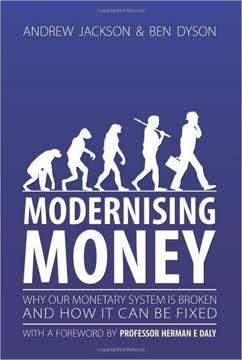
Most people believe that money is created by the government or the central bank. This belief is understandable. We see the central bank's name on our banknotes. We hear politicians talk about government spending and national debt. We assume that somewhere, in some vault, there is a pile of money that gets distributed through the economy. This belief is wrong. In modern economies, approximately 97 percent of the money supply is created not by governments or central banks, but by private commercial banks when they make loans. When a bank approves your mortgage or extends a line of credit to a business, it does not lend out money that someone else deposited. It simply creates new money by typing numbers into an account. That money did not exist before the loan was made. It exists because the bank created it. This single fact changes everything about how we understand the economy. The implications are profound. Banks determine how much money exists in the economy. They decide where that money goes. They profit from creating it. And when their lending decisions go wrong, as they inevitably do, the rest of society bears the cost. The financial crisis of 2007 and 2008 was not an accident. It was not the result of a few bad actors or insufficient regulation. It was the predictable outcome of a monetary system that delegates the creation of money to private institutions whose primary motivation is profit. The crisis cost the global economy somewhere between $60 and $200 trillion in lost output. Millions of people lost their homes, their jobs, and their savings. Governments spent trillions bailing out the very banks that caused the problem. And yet, more than a decade later, the fundamental structure of the monetary system remains unchanged. This book argues that we need to think differently about money. Not as a neutral tool that simply facilitates exchange, but as a foundational institution that shapes economic outcomes, distributes power, and determines who benefits from economic activity. The authors, Andrew Jackson and Ben Dyson, are part of a growing movement of economists, policymakers, and citizens who believe that…
Continue reading in the MinuteRead app
Get the complete 30-minute summary of Modernising Money
Get the complete summary in the appBanks create money when they make loans. They do not lend out existing deposits.
About 97 percent of money is created by commercial banks, not by governments or central banks.
The money supply is determined by banks' profit-seeking lending decisions, not by economic needs.
Bank lending is procyclical, causing boom-bust cycles and recurring financial crises.
The current system transfers wealth from the poor to the rich through interest payments on bank-created money.
The debt-based monetary system requires constant growth, creating pressure to prioritize growth over environmental prote
"Modernising Money" is a strong fit if you want practical ideas around economics, finance, business, especially themes like banks create money when they make loans. they do not lend out existing deposits; about 97 percent of money is created by commercial banks, not by governments or central banks. The MinuteRead summary distills these concepts into a focused read, whether you're deciding whether to buy the book or applying its lessons at work.
Andrew Jackson and Ben Dyson are experts in monetary reform and banking systems. Jackson has conducted extensive research on money creation and banking for the New Economics Foundation. Dyson founded Positive Money, a non-profit organization campaigning for a fair, democratic, and sustainable money system. Together, they bring a wealth of knowledge and innovative thinking to the complex issue of monetary reform, challenging conventional wisdom about how our financial system operates and proposin…
View all summaries by Andrew JacksonContinue Reading
Access the complete 30-minute summary and thousands more nonfiction books in the MinuteRead app.

Continue reading the complete summary in the MinuteRead app.