MinuteRead
30 min
Book summary
Premium summary · Opens in the app · 30 min read
Miyamoto Musashi killed his first man at thirteen. By thirty, he had fought more than sixty duels to the death and remained undefeated. In his later years, he retreated to a cave to write down what he had learned. The result was *The Book of Five Rings*, a work that has survived four centuries because it speaks to something deeper than swordsmanship.
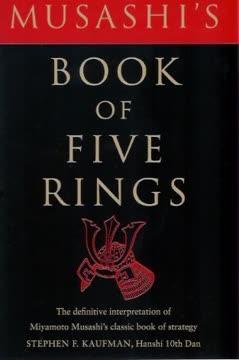
**Author:** Stephen F. Kaufman **Estimated Reading Time:** 45 minutes
**What You'll Learn:** The strategic principles that governed the life of Japan's greatest swordsman, and how those principles apply to every form of conflict, competition, and personal mastery. This is not a book about sword fighting. It is a book about winning.
**Who This Book Is For:** Anyone who faces opposition. Business leaders navigating competitive markets. Athletes seeking mental dominance. Artists striving for mastery. Anyone who has ever felt hesitation before a critical moment and wondered what separates those who act decisively from those who falter.
Miyamoto Musashi killed his first man at thirteen. By thirty, he had fought more than sixty duels to the death and remained undefeated. In his later years, he retreated to a cave to write down what he had learned. The result was *The Book of Five Rings*, a work that has survived four centuries because it speaks to something deeper than swordsmanship. Stephen F. Kaufman's interpretation strips away the cultural distance between modern readers and feudal Japan. What remains is a clear-eyed philosophy of conflict, strategy, and self-mastery that applies wherever human beings compete. The problem most people face is not a lack of knowledge. It is a lack of integration. They learn techniques without understanding principles. They study methods without developing the mind that makes those methods work. They train their bodies while neglecting their spirits. The result is a brittle competence that collapses under real pressure. Musashi understood this. He wrote his book not to teach sword techniques but to transmit a way of seeing. His central insight was that all forms of conflict share the same underlying structure. Whether you face an opponent with a sword, a competitor in business, or your own internal resistance, the principles of strategy remain constant. What makes this approach different is its insistence on totality. Musashi did not separate technical skill from spiritual development, or mental clarity from physical action. He saw them as one thing. The warrior who hesitates does so not because of poor training but because of a divided mind. The warrior who acts decisively does so not because of courage but because of unity of purpose. This book exists because the world still contains conflict, and people still need to learn how to navigate it without losing themselves. The swords may be metaphorical, but the stakes remain real. Every day presents moments that demand decisive action, clear perception, and unwavering commitment. Most people fail these moments not because they lack ability but because they lack the strategic mindset that Musashi taught. The chapters that follow are not a historical curiosity. They are a manual for anyone who wants to stop hesitating, start…
Continue reading in the MinuteRead app
Get the complete 30-minute summary of Musashi's Book of Five Rings
Get the complete summary in the appKnow your purpose with absolute clarity. If you cannot say what winning looks like, you cannot develop a strategy to ach
Perceive rhythm before trying to disrupt it. Every opponent, every situation, every market has a pattern. See it first.
Close the gap between decision and action. Hesitation is the enemy. When you decide, act.
Train until technique becomes automatic. The conscious mind should be the strategist, not the technician.
Adapt without losing your center. Water takes the shape of its container but remains water.
Commit completely to every action. Half-measures produce half-results and signal weakness.
"Musashi's Book of Five Rings" is a strong fit if you want practical ideas around philosophy, martial arts, japan, especially themes like know your purpose with absolute clarity. if you cannot say what winning looks like, you cannot develop a strategy to ach; perceive rhythm before trying to disrupt it. every opponent, every situation, every market has a pattern. see it first. The MinuteRead summary distills these concepts into a focused read, whether you're deciding whether to buy the book or applying its lessons at work.
Stephen F. Kaufman is a renowned speaker, educator, and author specializing in ancient wisdom applied to modern society. He has written interpretations of classic texts like "Sun Tzu's Art of War" and "Musashi's Book of Five Rings." Kaufman is considered an expert in negotiation, management, motivation, and personal development. He focuses on providing practical solutions to challenges in business, military, and personal realms. His approach involves transforming obstacles into opportunities thr…
View all summaries by Stephen F. KaufmanContinue Reading
Access the complete 30-minute summary and thousands more nonfiction books in the MinuteRead app.

Continue reading the complete summary in the MinuteRead app.