MinuteRead
30 min
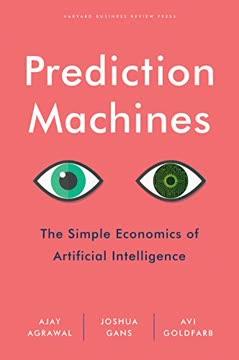
Book summary
by Ajay Agrawal
Premium summary · Opens in the app · 30 min read
Artificial intelligence is surrounded by confusion. Some people see it as magic, a technology so advanced it will soon surpass human capabilities in nearly every domain. Others dismiss it as overhyped, pointing to failures and limitations. Both perspectives miss what is actually happening.
**Author:** Ajay Agrawal
**Estimated Reading Time:** 45 minutes
**What You'll Learn:**
- Why artificial intelligence is best understood as a dramatic drop in the cost of prediction - How cheap prediction changes decision-making, business strategy, and entire industries - Where human judgment remains essential and how the division of labor between humans and machines will evolve - How to identify opportunities for AI in your own work and organization - What trade-offs society must navigate as prediction becomes abundant
**Who This Book Is For:**
This book is for anyone who wants to understand AI beyond the hype. Whether you are a business leader evaluating where AI fits into your strategy, a professional wondering how your role will change, an entrepreneur looking for new opportunities, or simply a curious reader trying to make sense of headlines about artificial intelligence, this book provides a clear economic lens for seeing what AI really is and what it means for the future.
Artificial intelligence is surrounded by confusion. Some people see it as magic, a technology so advanced it will soon surpass human capabilities in nearly every domain. Others dismiss it as overhyped, pointing to failures and limitations. Both perspectives miss what is actually happening. The confusion stems from the word "intelligence" itself. When we hear that machines are becoming intelligent, we naturally imagine them thinking, reasoning, and understanding the world the way humans do. We picture robots with consciousness, computers with intuition, systems that know things the way we know things. This mental model leads us astray. Ajay Agrawal and his colleagues at the University of Toronto's Creative Destruction Lab propose a different way of seeing AI. The current wave of artificial intelligence, they argue, is not about replicating human intelligence. It is about something far more specific and far more economically significant: the falling cost of prediction. Prediction is the process of filling in missing information. When you drive to work, you predict which route will be fastest given the time of day, the weather, and what you know about traffic patterns. When a doctor examines a patient, she predicts which disease is most likely given the symptoms. When a credit card company reviews a transaction, it predicts whether the charge is legitimate or fraudulent. Prediction is everywhere, and it has always been valuable. What makes prediction costly? It requires information, time, and cognitive effort. Humans are decent predictors in some domains but poor in others. We struggle with large datasets, complex interactions, and subtle patterns. We are inconsistent, biased, and slow. Machines, by contrast, can process vast amounts of data quickly and identify patterns that humans miss. The current AI revolution is fundamentally about making prediction dramatically cheaper, faster, and more…
Continue reading in the MinuteRead app
Get the complete 30-minute summary of Prediction Machines
Get the complete summary in the appAI is a dramatic reduction in the cost of prediction, not a replication of human intelligence.
Prediction is the process of filling in missing information using data you already have.
Every decision has two components: prediction and judgment. AI improves prediction. Humans provide judgment.
As prediction becomes cheaper, judgment becomes more valuable.
The ideal division of labor pairs machine prediction with human judgment.
Data moats come from feedback loops, not just data ownership.
"Prediction Machines" is a strong fit if you want practical ideas around artificial intelligence, business, economics, especially themes like ai is a dramatic reduction in the cost of prediction, not a replication of human intelligence; prediction is the process of filling in missing information using data you already have. The MinuteRead summary distills these concepts into a focused read, whether you're deciding whether to buy the book or applying its lessons at work.
Ajay Agrawal is a distinguished academic and entrepreneur in the field of innovation and artificial intelligence. As a professor at the University of Toronto's Rotman School of Management, he holds the Geoffrey Taber Chair in Entrepreneurship and Innovation and is also Professor of Strategic Management. Agrawal's contributions extend beyond academia; he co-founded NEXT Canada in 2010, an organization dedicated to fostering entrepreneurship. His work focuses on the economic and social implication…
View all summaries by Ajay AgrawalContinue Reading
Access the complete 30-minute summary and thousands more nonfiction books in the MinuteRead app.

Continue reading the complete summary in the MinuteRead app.