MinuteRead
30 min
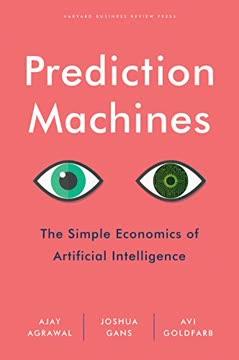
Book summary
by Ajay Agrawal
Premium summary · Opens in the app · 30 min read
The child asked Alexa a question. Alexa heard the sounds, predicted the words the child spoke, and then predicted what information those words were seeking. That is all. No understanding. No consciousness. No intelligence in the way humans experience it. Just prediction, executed with remarkable speed and accuracy.
**Author:** Ajay Agrawal
**Estimated Reading Time:** 45 minutes
**What You'll Learn:**
* Why artificial intelligence is fundamentally about cheaper prediction, not machine consciousness * How to break down any decision into its component parts to find where AI creates value * Why human judgment becomes more valuable as prediction gets cheaper * How AI reshapes jobs, workflows, and entire business models * What risks and policy trade-offs accompany the rise of prediction machines
**Who This Book Is For:**
This book is for business leaders trying to separate AI reality from AI hype, for professionals wondering how AI will reshape their careers, for entrepreneurs seeking to build AI-powered businesses, and for anyone who wants a clear mental model for understanding how artificial intelligence will transform the economy and society.
The child asked Alexa a question. Alexa heard the sounds, predicted the words the child spoke, and then predicted what information those words were seeking. That is all. No understanding. No consciousness. No intelligence in the way humans experience it. Just prediction, executed with remarkable speed and accuracy. This simple observation unlocks something profound about the current wave of artificial intelligence. The technology that powers voice assistants, autonomous vehicles, medical diagnosis systems, and fraud detection algorithms is not a step toward human-like general intelligence. It is something both more mundane and more transformative: a dramatic reduction in the cost of prediction. When the cost of something fundamental drops sharply, the world changes. The cost of lighting fell so dramatically over the nineteenth century that it transformed how people lived, worked, and built cities. The cost of computation fell so dramatically over the twentieth century that it reshaped every industry on earth. Now the cost of prediction is falling, and the consequences will be similarly far-reaching. Prediction is the process of using information you have to generate information you do not have. When you drive, you predict what other drivers will do. When you hire, you predict which candidate will perform best. When you price a product, you predict how customers will respond. Prediction is woven into nearly every decision we make. Artificial intelligence makes prediction cheap. A machine learning model trained on historical data can predict whether a loan applicant will default, which customers will churn, what a tumor looks like on a scan, or what word a child is trying to say. These predictions are not perfect, but they are fast, scalable, and increasingly accurate. And as prediction becomes cheap, it gets used in places where it was previously too expensive to apply. This shift creates enormous opportunities and enormous confusion. Business leaders hear that AI will transform everything, but they struggle to understand exactly how. They invest in data science…
Continue reading in the MinuteRead app
Get the complete 30-minute summary of Prediction Machines, Updated and Expanded
Get the complete summary in the appAI is cheap prediction, not intelligence. This reframing is the key to understanding everything else.
Every decision has four components: prediction, judgment, action, and data. AI improves the prediction component.
Judgment is about values and trade-offs. It becomes more valuable as prediction becomes cheaper.
AI reshapes jobs by automating prediction tasks and elevating judgment tasks. Most jobs will be transformed, not elimina
The strategic value of AI comes from enabling new business models, not just improving existing processes.
AI enables strategic change when it resolves trade-offs that are influenced by uncertainty.
"Prediction Machines, Updated and Expanded" is a strong fit if you want practical ideas around artificial intelligence, business, economics, especially themes like ai is cheap prediction, not intelligence. this reframing is the key to understanding everything else; every decision has four components: prediction, judgment, action, and data. ai improves the prediction component. The MinuteRead summary distills these concepts into a focused read, whether you're deciding whether to buy the book or applying its lessons at work.
Ajay Agrawal is a distinguished professor at the University of Toronto's Rotman School of Management, holding the Geoffrey Taber Chair in Entrepreneurship and Innovation and a professorship in Strategic Management. His academic work focuses on the economics of artificial intelligence, machine learning, and other emerging technologies. Agrawal is also known for his entrepreneurial initiatives, having co-founded NEXT Canada (formerly The Next 36) in 2010, an organization dedicated to fostering ent…
View all summaries by Ajay AgrawalContinue Reading
Access the complete 30-minute summary and thousands more nonfiction books in the MinuteRead app.

Continue reading the complete summary in the MinuteRead app.