MinuteRead
30 min
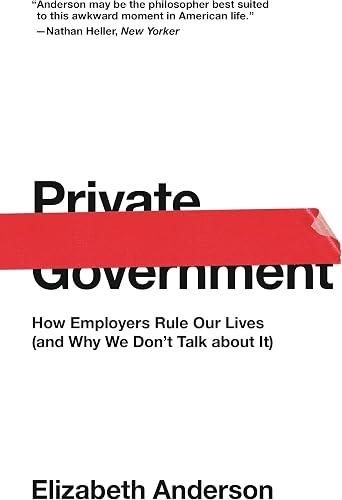
Book summary
by Elizabeth S. Anderson
Premium summary · Opens in the app · 30 min read
Imagine waking up each morning and entering a place where someone else controls nearly every aspect of your existence. They decide when you arrive, when you leave, what you wear, how you speak, whom you may associate with, what you may say publicly, and even what you may do in your private hours. They can monitor your communications, search your belongings, demand access to your body through drug tests, and dismiss you without warning or explanation. You have no right to vote on the rules that g
**Author:** Elizabeth S. Anderson
**Estimated Reading Time:** 42 minutes
**What You'll Learn:**
- Why the modern workplace resembles an authoritarian state - How the original vision of free markets was egalitarian and liberating - Why economists and political theorists have overlooked workplace tyranny - What employer power actually looks like in daily life - How workplace governance could be reformed to honor freedom and equality
**Who This Book Is For:**
Anyone who has ever felt powerless at work. Anyone who has wondered why democratic rights stop at the office door. Anyone interested in the hidden structures of power that shape modern life. Anyone who believes freedom and equality should mean something beyond the voting booth.
Imagine waking up each morning and entering a place where someone else controls nearly every aspect of your existence. They decide when you arrive, when you leave, what you wear, how you speak, whom you may associate with, what you may say publicly, and even what you may do in your private hours. They can monitor your communications, search your belongings, demand access to your body through drug tests, and dismiss you without warning or explanation. You have no right to vote on the rules that govern you. You have no right to due process before punishment. You have no guaranteed freedom of speech, association, or privacy. This is not a description of life under a totalitarian regime. This is a description of ordinary employment in the United States. Elizabeth Anderson, one of America's most distinguished political philosophers, argues that we have a blind spot when it comes to power. We spend enormous energy debating the proper limits of government authority. We worry about tyranny in the public sphere. We celebrate democratic institutions that check state power and protect individual rights. Yet we rarely notice that most people spend most of their waking hours governed by institutions that are, in Anderson's words, essentially dictatorships. The workplace, she argues, is a form of private government. Employers exercise sweeping authority over their employees. They make rules unilaterally. They enforce those rules without due process. They face no democratic accountability to the people they govern. And this authority extends far beyond the performance of work tasks. It reaches into employees' political speech, their romantic lives, their consumption habits, their health choices, and their off-duty conduct. This is not a marginal phenomenon. The vast majority of American workers live under such private government for most of their adult lives. The consequences for freedom, equality, and human dignity are profound. Anderson's book is not a call for revolution. It is a call for recognition. She wants us to see what is actually in front of us. She wants us to…
Continue reading in the MinuteRead app
Get the complete 30-minute summary of Private Government
Get the complete summary in the appThe workplace is a form of government, and it is a form of government that would be intolerable if imposed by the state.
The original advocates of market society were egalitarians who saw markets as a weapon against concentrated power.
The Industrial Revolution shattered the egalitarian vision by concentrating capital and creating a class of dependent wa
Employers exercise sweeping authority over employees, extending far beyond the performance of work tasks into workers' p
The legal doctrine of at-will employment gives employers enormous power over workers, with no due process or appeal.
Most workers live in a state of republican unfreedom, subject to the arbitrary will of their employers.
"Private Government" is a strong fit if you want practical ideas around philosophy, politics, economics, especially themes like the workplace is a form of government, and it is a form of government that would be intolerable if imposed by the state; the original advocates of market society were egalitarians who saw markets as a weapon against concentrated power. The MinuteRead summary distills these concepts into a focused read, whether you're deciding whether to buy the book or applying its lessons at work.
Motivated to help readers with opposition to economic monopolies was part of a broader agenda of dismantling monopolies across all domains, Elizabeth S. Anderson wrote “Private Government” to package those ideas for a fast, focused read. In “Private Government”, Elizabeth S. Anderson focuses on opposition to economic monopolies was part of a broader agenda of dismantling monopolies across all domains. Through “Private Government”, Elizabeth S. Anderson distills the core ideas on philosophy into …
Continue Reading
Access the complete 30-minute summary and thousands more nonfiction books in the MinuteRead app.

Continue reading the complete summary in the MinuteRead app.