MinuteRead
30 min
Book summary
Premium summary · Opens in the app · 30 min read
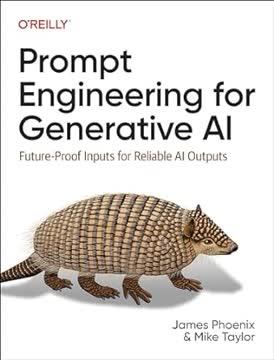
Generative AI has created a strange paradox. The tools are more accessible than ever, yet getting them to do exactly what you want remains surprisingly difficult. Anyone can type a request into ChatGPT and receive a plausible response. But ask the same model to produce valid JSON a hundred times in a row, and you will quickly discover the gap between casual use and reliable engineering.
**Author:** James Phoenix
**Estimated Reading Time:** 45 minutes
**What You'll Learn:**
- The five timeless principles that make any prompt more reliable - How large language models and diffusion models actually work - Practical techniques for generating structured, consistent text output - How to build advanced AI workflows with frameworks like LangChain - How to use vector databases and retrieval augmented generation - How to create autonomous agents that reason and act - Professional techniques for controlling AI image generation - How to integrate everything into end-to-end applications
**Who This Book Is For:**
This book is for developers, product builders, content creators, and technical professionals who want to move beyond casual experimentation with generative AI. If you have ever been frustrated by inconsistent outputs, struggled to integrate AI into a production system, or wondered how to reliably control what a model produces, this book provides the systematic foundation you need. No advanced machine learning background is required, but familiarity with basic programming concepts will help you get the most from the technical examples.
Generative AI has created a strange paradox. The tools are more accessible than ever, yet getting them to do exactly what you want remains surprisingly difficult. Anyone can type a request into ChatGPT and receive a plausible response. But ask the same model to produce valid JSON a hundred times in a row, and you will quickly discover the gap between casual use and reliable engineering. This gap is where most people get stuck. They treat AI models as if they were search engines or simple command-line tools, expecting deterministic outputs from systems that are fundamentally probabilistic. When the results disappoint, they blame the model. But the real issue is often the input. Prompt engineering exists because the quality of what you get from a generative AI system depends enormously on what you put into it. A well-crafted prompt can transform a vague, unreliable model into a dependable component of an automated workflow. A poorly crafted prompt wastes computational resources, produces inconsistent results, and creates hours of manual correction work. James Phoenix wrote this book to address a specific problem: the gap between the promise of generative AI and the practical reality of building with it. The field has attracted enormous attention, but much of the available guidance is shallow. Blog posts offer lists of tricks. Social media threads share screenshots of impressive outputs without explaining the underlying principles. What is missing is a systematic approach. Phoenix argues that prompt engineering is not a bag of tricks. It is a discipline. It has principles that hold across models and modalities, from text generation to image synthesis. It requires understanding how these models actually work, not just how…
Continue reading in the MinuteRead app
Get the complete 30-minute summary of Prompt Engineering for Generative AI
Get the complete summary in the app**Give direction, specify format, provide examples, evaluate quality, divide labor.** These five principles apply to eve
**Examples beat instructions.** Show the model what you want rather than just telling it.
**Models are probabilistic, not deterministic.** Expect variation. Design for it.
**Chain-of-thought reasoning improves complex task performance.** Give models room to think step by step.
**RAG grounds responses in your data.** Use vector databases to inject relevant context into prompts.
**Agents combine reasoning with action.** Tools expand model capabilities beyond text generation.
"Prompt Engineering for Generative AI" is a strong fit if you want practical ideas around artificial intelligence, technology, programming, especially themes like **give direction, specify format, provide examples, evaluate quality, divide labor.** these five principles apply to eve; **examples beat instructions.** show the model what you want rather than just telling it. The MinuteRead summary distills these concepts into a focused read, whether you're deciding whether to buy the book or applying its lessons at work.
James Phoenix is the author of Prompt Engineering for Generative AI . While limited information is provided about the author in the given content, it can be inferred that Phoenix has expertise in the field of artificial intelligence and prompt engineering. The book covers various aspects of generative AI, including text and image generation, as well as tools like LangChain and Stable Diffusion. Phoenix's writing style is described as accessible, with clear explanations of complex concepts. Howev…
View all summaries by James PhoenixContinue Reading
Access the complete 30-minute summary and thousands more nonfiction books in the MinuteRead app.

Continue reading the complete summary in the MinuteRead app.