MinuteRead
30 min
Book summary
Premium summary · Opens in the app · 5 min read
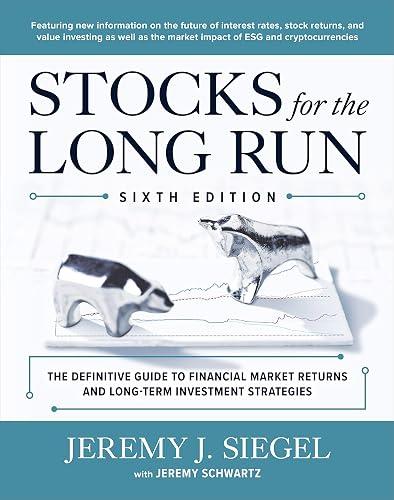
Stocks for the Long Run delves into the subject of investing and the implications that come with picking securities, whether they’re stocks, bonds, or commodities, having in mind the generally higher returns of stocks over the years and how to build a balanced portfolio that can face times of crisis.
Stocks for the Long Run delves into the subject of investing and the implications that come with picking securities, whether they’re stocks, bonds, or commodities, having in mind the generally higher returns of stocks over the years and how to build a balanced portfolio that can face times of crisis.
In finance and economics, there is a universal conception that bonds are safer investments than stocks. If you look at them from a volatility ratio perspective, stocks will definitely fluctuate more than bonds, with no promise to deliver returns. In contrast to that, they can even wipe out your life savings if you’re not careful.
However, there are many factors to consider when investing in stocks over bonds. To start with, they’ve proven to be better investments over prolonged time frames, delivering higher returns than bonds, after inflation. Given a period of twenty years, Siegel suggests that any decent company will deliver positive returns for its investors.
Essentially, bonds are less volatile, but they deliver fewer profits over time, while sometimes they can’t even keep up with inflation. That’s because bonds move according to the interest rate, which sometimes doesn’t work in the investor’s favor. Let’s take the 1946-2001 time frame. During this period, stocks have produced an average return of 6,8% and gold had a -0,1% return. Meanwhile, bonds had an annual real return of -2,8%. Moreover, the data doesn’t include the average dividend rate of 4,6% annually.
Although it seems that stocks have more ups and downs, they are definitely less risky. That’s because the other securities can’t always keep up with the inflation rate. Let alone deliver a positive return for investors. Isn’t placing a possible winning trade less risky than placing an undeniably losing one?
The market is an efficient mechanism for placing trades and finding stocks of all sorts. However, when it comes to the price of stocks, it may not always show the true value of a security. Investors have a tendency to switch from over-optimism to exaggerated pessimism, thus the volatility of this industry. As such, an instrument has an intrinsic value, given by the value of the company (revenue, management effectiveness, profit margin, cash flow, and many other aspects) and the value of its stock price, which doesn’t necessarily reflect the first. A company listed on the stock exchange is rarely properly valued, and it is the investor’s job to determine whether a stock is worth buying or currently undervalued. Stocks fluctuate for numerous reasons. Siegel suggests that the “noisy market hypothesis” is a good potential explanation for this. It states that stocks are being pushed away from their real prices by investors trading for unrelated purposes. These include tax harvesting, rebalancing…
Continue reading in the MinuteRead app
Get the complete 5-minute summary of Stocks for the Long Run
Get the complete summary in the appStocks may not be as risky as they seem if you give the market sufficient time to prove their worth.
Stocks are not always priced according to their underlying value.
Keep your money invested in ETFs and find value stocks.
"Stocks for the Long Run" is a strong fit if you want practical ideas around economics, business, finance, especially themes like stocks may not be as risky as they seem if you give the market sufficient time to prove their worth; stocks are not always priced according to their underlying value. The MinuteRead summary distills these concepts into a focused read, whether you're deciding whether to buy the book or applying its lessons at work.
Motivated to help readers with stocks for the Long Run delves into the subject of investing and the implications that come with picking, Jeremy J. Siegel wrote “Stocks for the Long Run” to package those ideas for a fast, focused read. In “Stocks for the Long Run”, Jeremy J. Siegel focuses on stocks for the Long Run delves into the subject of investing and the implications that come with picking. Through “Stocks for the Long Run”, Jeremy J. Siegel distills the core ideas on economics into lessons…
View all summaries by Jeremy J. SiegelContinue Reading
Access the complete 5-minute summary and thousands more nonfiction books in the MinuteRead app.

Continue reading the complete summary in the MinuteRead app.