MinuteRead
30 min
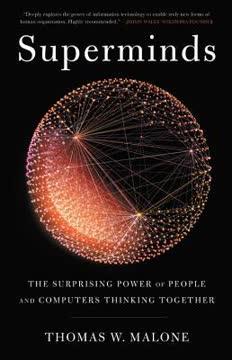
Book summary
Premium summary · Opens in the app · 30 min read
Every great human achievement has a hidden author. The lightbulb was not invented by Thomas Edison alone. The theory of evolution did not spring fully formed from Darwin's mind. The internet was not built by any single visionary. Behind each of these breakthroughs stood a network of collaborators, rivals, predecessors, and supporters whose combined thinking made the achievement possible.
**Author:** Thomas W. Malone
**Estimated Reading Time:** 45 minutes
**What You'll Learn:**
- Why groups of people, not lone geniuses, have driven nearly all human progress - The five fundamental ways humans organize themselves to think and act collectively - How computers are transforming from tools into thinking partners - Why the future belongs to those who can combine human judgment with machine intelligence - Practical ways to harness collective intelligence in your own life and work
**Who This Book Is For:**
This book is for anyone who has ever wondered how great things actually get accomplished. It is for leaders trying to make their teams smarter, entrepreneurs seeking to build organizations that learn, and curious readers who sense that the most important developments of our time are not about individual brilliance but about collective capability. If you have ever been part of a group that seemed to think better than any single member, or a team that somehow thought worse, this book will explain why.
Every great human achievement has a hidden author. The lightbulb was not invented by Thomas Edison alone. The theory of evolution did not spring fully formed from Darwin's mind. The internet was not built by any single visionary. Behind each of these breakthroughs stood a network of collaborators, rivals, predecessors, and supporters whose combined thinking made the achievement possible. Yet our stories about genius remain stubbornly individual. We celebrate the lone inventor, the solitary visionary, the brilliant founder. We ask who had the idea, as if ideas arrive whole in single minds. This way of thinking blinds us to the most important truth about human capability: nearly everything significant that humans have ever accomplished was accomplished by groups. Thomas W. Malone, a professor at MIT and the founding director of the MIT Center for Collective Intelligence, has spent decades studying how groups think. His research has revealed something both simple and profound. Groups can be intelligent in measurable ways. Some groups are smarter than others. And the difference between smart groups and dumb groups is not mysterious. It can be understood, measured, and improved. Malone calls these intelligent groups "superminds." A supermind is a group of individuals acting together in ways that seem intelligent. The term applies to hierarchies like corporations and armies, to markets where millions of buyers and sellers coordinate through prices, to communities bound by shared norms, to democracies that aggregate preferences through voting, and to ecosystems where all these forms interact. Superminds are everywhere. They have always been everywhere. What is new is our ability to understand them and, increasingly, to design them. The urgency of understanding superminds has grown because of a technological shift. For decades, the dominant story…
Continue reading in the MinuteRead app
Get the complete 30-minute summary of Superminds
Get the complete summary in the appIntelligence is a property of groups, not just individuals. The most important intelligence on Earth has always been col
Collective intelligence can be measured and improved. It depends on social perceptiveness, equal participation, and dive
There are five types of superminds: hierarchies, markets, communities, democracies, and ecosystems. Each has strengths a
No single type of supermind is always best. The art of design is matching type to task.
Markets are cognitive systems. Prices aggregate distributed knowledge that no individual possesses.
Hyperconnectivity is transforming work by making communication nearly free. This enables new forms of organization.
"Superminds" is a strong fit if you want practical ideas around artificial intelligence, science, technology, especially themes like intelligence is a property of groups, not just individuals. the most important intelligence on earth has always been col; collective intelligence can be measured and improved. it depends on social perceptiveness, equal participation, and dive. The MinuteRead summary distills these concepts into a focused read, whether you're deciding whether to buy the book or applying its lessons at work.
Thomas W. Malone is a professor at MIT known for his work on collective intelligence and organizational dynamics. He pioneered research on measuring group intelligence and has contributed significantly to understanding how technology impacts collaborative work. Malone's expertise spans management, computer science, and cognitive science. His work often explores the intersection of human and artificial intelligence, focusing on how groups can work together more effectively using technology. As th…
View all summaries by Thomas W. MaloneContinue Reading
Access the complete 30-minute summary and thousands more nonfiction books in the MinuteRead app.

Continue reading the complete summary in the MinuteRead app.