MinuteRead
30 min
Book summary
by Calum Chace
Premium summary · Opens in the app · 30 min read
Imagine standing at the dawn of the Industrial Revolution. Steam engines are beginning to power factories. Machines are starting to do work that human muscles performed for millennia. You can see the outlines of massive change, but the full shape of the future remains unclear. Some people are excited. Others are terrified. Most are simply unaware of how profoundly their world is about to shift.
### By Calum Chace
**Estimated Reading Time:** 42 minutes
**What You'll Learn:**
* The difference between narrow AI, artificial general intelligence, and superintelligence * Why the next few decades may transform human civilization more than any previous era * The economic disruption automation will bring and how societies might respond * The paths researchers are taking toward human-level machine intelligence * The existential risks posed by superintelligent systems and how we might address them
**Who This Book Is For:**
This book is for anyone who wants to understand what artificial intelligence really means for humanity. You do not need a technical background. You need curiosity about the most consequential technology ever developed. Whether you are a business leader planning for disruption, a policymaker concerned about societal stability, a student choosing a career, or simply a thoughtful person wondering what the future holds, this book will give you a clear-eyed view of the possibilities ahead.
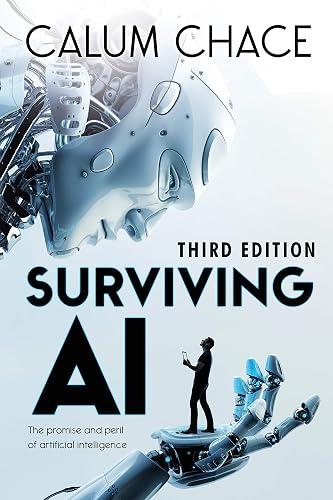
Imagine standing at the dawn of the Industrial Revolution. Steam engines are beginning to power factories. Machines are starting to do work that human muscles performed for millennia. You can see the outlines of massive change, but the full shape of the future remains unclear. Some people are excited. Others are terrified. Most are simply unaware of how profoundly their world is about to shift. Now imagine standing at the dawn of a different revolution. This time, machines are not replacing human muscle. They are beginning to replace human cognition. They are learning to see, to hear, to understand language, to make decisions, to create. They are not yet as smart as humans across the board, but they are improving at a pace that has no historical precedent. This is where we stand today. Calum Chace wrote *Surviving AI* to address a simple but urgent question: what happens when machines become smarter than we are? It is a question that sounds like science fiction. For decades, it was confined to the pages of novels and the frames of films. But in recent years, it has migrated from speculation to serious academic inquiry. Researchers at leading universities now debate it. Technology companies now fund teams dedicated to it. Governments now hold hearings about it. The reason for this shift is straightforward. Artificial intelligence is no longer a distant possibility. It is already here. The AI that exists today is narrow. It can beat the world champion at Go. It can translate between dozens of languages. It can drive cars, diagnose diseases, and compose music. But it cannot do all of these things at once. It cannot reason about the world the way a human child can. It cannot set its own goals or reflect on its own…
Continue reading in the MinuteRead app
Get the complete 30-minute summary of Surviving AI
Get the complete summary in the appArtificial intelligence is the most powerful technology humanity has ever developed, and it will transform civilization
Narrow AI is already ubiquitous, but it is fundamentally different from artificial general intelligence, which would mat
The economic singularity, the point at which automation disrupts the relationship between labor and income, may arrive w
The timeline for AGI is uncertain, but the median prediction among researchers is around the middle of this century. Unc
Superintelligence would be the best or worst thing ever to happen to humanity. The outcome depends on whether we can ali
The control problem, the challenge of ensuring that a superintelligent AI acts in accordance with human interests, is fu
"Surviving AI" is a strong fit if you want practical ideas around artificial intelligence, ai, technology, especially themes like artificial intelligence is the most powerful technology humanity has ever developed, and it will transform civilization; narrow ai is already ubiquitous, but it is fundamentally different from artificial general intelligence, which would mat. The MinuteRead summary distills these concepts into a focused read, whether you're deciding whether to buy the book or applying its lessons at work.
Motivated to help readers with "AI is humanity's most powerful technology." Narrow AI is ubiquitous, Calum Chace wrote “Surviving AI” to package those ideas for a fast, focused read. In “Surviving AI”, Calum Chace focuses on "AI is humanity's most powerful technology." Narrow AI is ubiquitous. Through “Surviving AI”, Calum Chace distills the core ideas on artificial intelligence into lessons readers can absorb in a single short sitting. Readers turn to this work when they want Calum Chace's pers…
Continue Reading
Access the complete 30-minute summary and thousands more nonfiction books in the MinuteRead app.

Continue reading the complete summary in the MinuteRead app.