MinuteRead
30 min
Book summary
by Timothy Williamson
Premium summary · Opens in the app · 30 min read
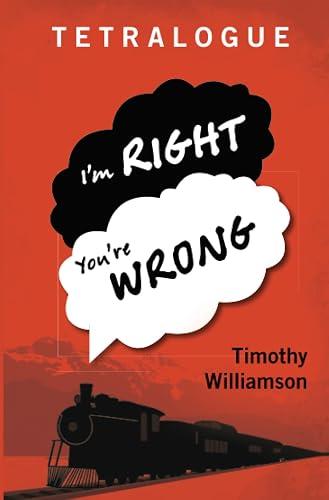
Most books about truth and knowledge are written as lectures. A single author presents a position, defends it against objections, and leaves the reader to accept or reject the argument. This book takes a different approach. Timothy Williamson, one of the world's most distinguished philosophers, has written a philosophical dialogue in which four characters with radically different perspectives argue about some of the deepest questions human beings can ask.
**Author:** Timothy Williamson
**Estimated Reading Time:** 3 hours 15 minutes
**What You'll Learn:**
- How ordinary disagreements can reveal deep philosophical questions - Why the nature of truth, knowledge, and rationality matters in everyday life - How to think more clearly about what you believe and why you believe it - What happens when four very different people try to understand each other - How to engage with perspectives radically different from your own
**Who This Book Is For:**
This book is for anyone who has ever argued with someone and wondered why the other person could not see what seemed obvious. It is for readers who want to understand how intelligent people can disagree so fundamentally. It is for those who suspect that beneath everyday disputes lie profound questions about truth, evidence, and the limits of human understanding. If you have ever felt frustrated by a conversation that went nowhere, or fascinated by one that opened new ways of seeing, this book will give you tools to understand both experiences.
Most books about truth and knowledge are written as lectures. A single author presents a position, defends it against objections, and leaves the reader to accept or reject the argument. This book takes a different approach. Timothy Williamson, one of the world's most distinguished philosophers, has written a philosophical dialogue in which four characters with radically different perspectives argue about some of the deepest questions human beings can ask. The format is not a stylistic choice. It reflects a fundamental insight about how thinking actually works. We do not form beliefs in isolation. We form them in conversation, in argument, in the messy back-and-forth of trying to understand what someone else means and why they believe what they believe. Philosophy, at its best, is not a monologue. It is a dialogue. The four characters in this book find themselves together on a train. Sarah is a scientist who trusts empirical evidence and careful observation. Bob is a skeptic who questions whether we can really know anything at all. Zac is a relativist who believes that truth is always truth for someone, from some perspective. Roxana is a pragmatist who cares less about abstract truth than about what works in practice. They do not know each other. They have no reason to be polite. And over the course of their journey, they push each other into increasingly difficult territory. What makes the dialogue so effective is that no character is simply a straw man. Each one makes genuine points. Each one exposes real weaknesses in the others' positions. The reader may find themselves agreeing with Sarah in one chapter, then with Bob in the next, then with Zac, then with…
Continue reading in the MinuteRead app
Get the complete 30-minute summary of Tetralogue
Get the complete summary in the appPhilosophical questions arise in ordinary situations. You do not need to be a philosopher to encounter them.
Truth is objective, but our access to it is fallible. We can be wrong about things we are confident about.
Knowledge requires justification, but justification does not guarantee truth. We can have good reasons for false beliefs
Evidence is essential for rational belief, but it is not self-interpreting. It must be interpreted within a framework of
Rationality has limits. Human beings are not perfectly rational, and our reasoning is subject to biases.
Disagreement is not always a sign of error. Reasonable people can disagree about complex questions.
"Tetralogue" is a strong fit if you want practical ideas around philosophy, politics, political, especially themes like philosophical questions arise in ordinary situations. you do not need to be a philosopher to encounter them; truth is objective, but our access to it is fallible. we can be wrong about things we are confident about. The MinuteRead summary distills these concepts into a focused read, whether you're deciding whether to buy the book or applying its lessons at work.
Motivated to help readers with the Five Laws cannot be negotiated with—either a business or nation kills the FLD, Timothy Williamson wrote “Tetralogue” to package those ideas for a fast, focused read. In “Tetralogue”, Timothy Williamson focuses on the Five Laws cannot be negotiated with—either a business or nation kills the FLD. Through “Tetralogue”, Timothy Williamson distills the core ideas on philosophy into lessons readers can absorb in a single short sitting. Readers turn to this work when …
Continue Reading
Access the complete 30-minute summary and thousands more nonfiction books in the MinuteRead app.

Continue reading the complete summary in the MinuteRead app.