MinuteRead
30 min
Book summary
Premium summary · Opens in the app · 30 min read
Humanity has lived through many technological revolutions. The printing press democratized knowledge. The industrial revolution multiplied physical power. The internet connected the globe. Each transformation changed how we live, work, and relate to one another. But each left one thing fundamentally unchanged: the human mind remained the sole source of reason, judgment, and decision-making in our world.
**Author:** Henry Kissinger **Estimated Reading Time:** 45 minutes
**What You'll Learn:** How artificial intelligence is reshaping knowledge, power, and human identity. Why AI represents not just another technology but a fundamental shift in the human condition. What nations, societies, and individuals must understand to navigate an era where machines learn, evolve, and make decisions that shape our world.
**Who This Book Is For:** Leaders, policymakers, and citizens who sense that AI is more than a technical revolution. Anyone who wants to understand how artificial intelligence will transform geopolitics, security, personal autonomy, and the very meaning of being human. This book is for those who recognize that the questions AI raises are too important to leave to technologists alone.
Humanity has lived through many technological revolutions. The printing press democratized knowledge. The industrial revolution multiplied physical power. The internet connected the globe. Each transformation changed how we live, work, and relate to one another. But each left one thing fundamentally unchanged: the human mind remained the sole source of reason, judgment, and decision-making in our world. Artificial intelligence changes this. For the first time in history, we are developing technologies that can learn, reason, and make decisions independently of human direction. AI does not simply execute instructions. It discovers patterns invisible to us. It generates solutions we never considered. It makes choices whose logic we cannot always trace. This is not an incremental advance. It is a philosophical rupture. The challenge AI presents is not primarily technical. It is human. How do we maintain control over systems that think differently than we do? How do we preserve human dignity when machines surpass our capabilities in domain after domain? How do nations compete and cooperate when AI reshapes the foundations of military power? What happens to human identity when we interact daily with entities that seem to understand us but whose inner experience, if any exists, remains utterly alien? These questions demand attention from people who have never written a line of code. They require wisdom from philosophy, history, strategy, and ethics, not just engineering. The conversation about AI has been dominated by technologists and business leaders. Their contributions are essential but insufficient. The issues AI raises touch the deepest questions of human existence: What is consciousness? What is the basis of human worth? How should we live together? This book is an invitation to that broader conversation. It does not offer simple answers. The future of AI is not predetermined. It will be shaped by choices we make, individually and collectively, in the years ahead. But making wise choices requires understanding what is genuinely new about this technology and what is at stake. The authors bring a distinctive perspective to these…
Continue reading in the MinuteRead app
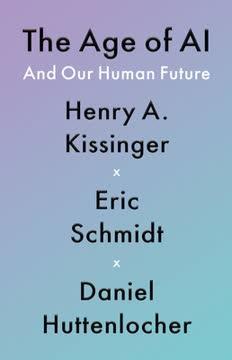
Get the complete 30-minute summary of The Age of A.I. and Our Human Future
Get the complete summary in the appAI is not just a tool. It is a new kind of actor that learns, adapts, and makes decisions independently of direct human
AI generates knowledge through pattern recognition, not theoretical understanding. We can know something is true without
AI is not objective. It reflects the biases in its training data and the values embedded in its objectives.
Network platforms powered by AI shape human attention and perception at global scale, optimizing for engagement rather t
AI is transforming military power and international security, introducing new risks of escalation, miscalculation, and l
Human identity and relationships are being reshaped by interaction with AI systems that simulate empathy and understandi
"The Age of A.I. and Our Human Future" is a strong fit if you want practical ideas around artificial intelligence, technology, science, especially themes like ai is not just a tool. it is a new kind of actor that learns, adapts, and makes decisions independently of direct human; ai generates knowledge through pattern recognition, not theoretical understanding. we can know something is true without. The MinuteRead summary distills these concepts into a focused read, whether you're deciding whether to buy the book or applying its lessons at work.
Henry Alfred Kissinger , born Heinz Alfred Kissinger, was a German-American diplomat and political scientist. He served as National Security Advisor and Secretary of State under Presidents Nixon and Ford. Kissinger was a key figure in U.S. foreign policy from 1969 to 1977, advocating for Realpolitik and pioneering détente. He received the Nobel Peace Prize in 1973. Kissinger's tenure was marked by controversial decisions and policies, making him a polarizing figure. He survived the Watergate sca…
View all summaries by Henry KissingerContinue Reading
Access the complete 30-minute summary and thousands more nonfiction books in the MinuteRead app.

Continue reading the complete summary in the MinuteRead app.