MinuteRead
30 min
Book summary
by Emily M. Bender
Premium summary · Opens in the app · 30 min read
The year is 2023. A lawyer stands before a federal judge in New York, attempting to explain why his legal filing cites cases that do not exist. The cases were generated by ChatGPT, which had confidently invented them, complete with plausible-sounding citations and procedural details. The lawyer claimed he did not understand that the tool could fabricate information. The judge was not sympathetic.
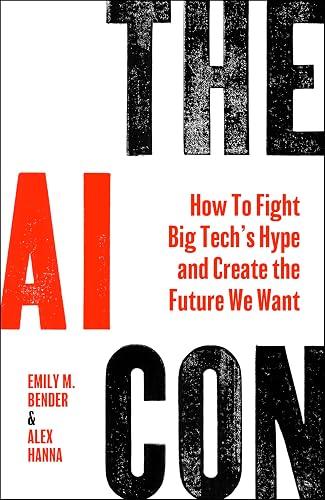
**Author:** Emily M. Bender
**Estimated Reading Time:** 45 minutes
**What You'll Learn:**
- Why the term "artificial intelligence" is primarily a marketing label rather than a technical description - How the hype around AI distracts from real, immediate harms affecting real people - The hidden labor, environmental costs, and social consequences behind AI systems - Practical strategies for questioning AI claims and resisting harmful automation - How to think clearly about what these technologies actually do and do not do
**Who This Book Is For:**
This book is for anyone who has felt uneasy about the relentless march of AI into every corner of life but struggled to articulate why. It is for workers worried about their jobs, parents concerned about their children's relationship with technology, citizens troubled by government adoption of automated systems, and readers who suspect that the promises of AI are outpacing its actual capabilities. It is also for those who want to move beyond vague anxiety and toward informed, practical resistance.
The year is 2023. A lawyer stands before a federal judge in New York, attempting to explain why his legal filing cites cases that do not exist. The cases were generated by ChatGPT, which had confidently invented them, complete with plausible-sounding citations and procedural details. The lawyer claimed he did not understand that the tool could fabricate information. The judge was not sympathetic. Around the same time, a mayor in a major American city unveils a chatbot designed to help small business owners navigate regulations. Within days, investigative journalists discover the chatbot is dispensing advice that is not merely wrong but actively illegal: telling employers they can take their workers' tips, informing landlords they can discriminate against tenants receiving rental assistance. The city quietly adjusts the bot but keeps it live. Meanwhile, in Gaza, an AI targeting system called "Lavender" is generating lists of suspected militants at a rate no human analyst could match. The system's error rate, according to its own operators, is around ten percent. The consequences of that error rate are measured in civilian casualties. These stories share a common thread. In each case, a technology marketed as "artificial intelligence" was deployed with promises of efficiency, accuracy, and progress. In each case, the technology failed in predictable ways. And in each case, the failure was treated as an anomaly rather than a feature of the underlying approach. This book argues that these are not anomalies. They are the point. The term "artificial intelligence" has become one of the most successful marketing campaigns in the history of technology. It conjures images of thinking machines, of computers approaching human-level cognition, of a future that is either utopian or apocalyptic depending on whom you ask.…
Continue reading in the MinuteRead app
Get the complete 30-minute summary of The AI Con
Get the complete summary in the appArtificial intelligence is a marketing label, not a technical description. The systems sold as AI are statistical patter
Large language models do not understand language. They predict the next most likely word based on patterns in their trai
The ELIZA effect makes us attribute understanding to systems that have none. This tendency is being exploited at scale.
The concept of "general intelligence" has racist and eugenicist roots. The pursuit of AGI carries this history forward.
AI degrades work more often than it replaces workers. It intensifies surveillance, de-skills tasks, and shifts risk to e
The illusion of autonomous AI is maintained by exploited workers who are paid poverty wages and exposed to psychological
"The AI Con" is a strong fit if you want practical ideas around artificial intelligence, technology, science, especially themes like artificial intelligence is a marketing label, not a technical description. the systems sold as ai are statistical patter; large language models do not understand language. they predict the next most likely word based on patterns in their trai. The MinuteRead summary distills these concepts into a focused read, whether you're deciding whether to buy the book or applying its lessons at work.
Motivated to help readers with artificial intelligence, Emily M. Bender wrote “The AI Con” to package those ideas for a fast, focused read. In “The AI Con”, Emily M. Bender focuses on artificial intelligence. Through “The AI Con”, Emily M. Bender distills the core ideas on artificial intelligence into lessons readers can absorb in a single short sitting. Readers turn to this work when they want Emily M. Bender's perspective on the subject without working through the entire original volume. Emily…
Continue Reading
Access the complete 30-minute summary and thousands more nonfiction books in the MinuteRead app.

Continue reading the complete summary in the MinuteRead app.