MinuteRead
30 min
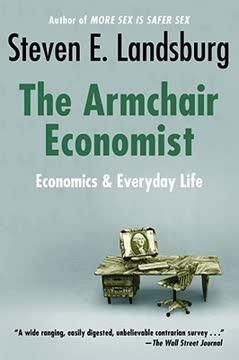
Book summary
Premium summary · Opens in the app · 30 min read
Most people think economics is about money, banking, and stock markets. They imagine economists as people who forecast interest rates or argue about tax policy. Steven Landsburg sees something entirely different. To him, economics is a way of seeing. It is a lens that reveals the hidden logic of human behavior, a tool for solving the mysteries of everyday life.
**Author:** Steven E. Landsburg **Estimated Reading Time:** 45 minutes
### What You'll Learn
Why seat belts might cause more pedestrian deaths. Why popcorn costs so much at movie theaters. Why recycling paper could lead to fewer trees. Why the used car you're eyeing might be a lemon precisely because it's for sale. This condensed edition of Steven Landsburg's classic will teach you to see the hidden logic behind everyday events, and to recognize the incentives that quietly shape human behavior in ways most people never notice.
### Who This Book Is For
This book is for anyone who has ever wondered why the world works the way it does. It is for readers who suspect that conventional wisdom often misses the real story. It is for people who want to think more clearly about policy, business, and daily decisions. You do not need a background in economics. You only need curiosity and a willingness to have your assumptions challenged.
Most people think economics is about money, banking, and stock markets. They imagine economists as people who forecast interest rates or argue about tax policy. Steven Landsburg sees something entirely different. To him, economics is a way of seeing. It is a lens that reveals the hidden logic of human behavior, a tool for solving the mysteries of everyday life. The central mystery is simple. Why do people do what they do? Why do well-intentioned policies so often produce disastrous results? Why do seemingly irrational behaviors turn out to be perfectly sensible once you understand the incentives at play? Landsburg wrote The Armchair Economist to answer these questions. The book's premise is that you do not need a PhD to think like an economist. You do not need complex mathematics or access to data. You need only a few core principles and the willingness to apply them consistently, even when the conclusions make you uncomfortable. The problem is that most people resist economic thinking. They prefer comfortable stories to uncomfortable truths. They want to believe that good intentions lead to good outcomes, that obvious solutions work, and that the world is simpler than it really is. Economics constantly disrupts these beliefs. Consider a simple question. Do seat belts make driving safer? The obvious answer is yes. Seat belts protect people in accidents. But the economic answer is more complicated. When drivers feel safer, they may drive faster or pay less attention. The result is that while seat belts protect drivers, they may increase accidents involving pedestrians and cyclists. The total number of deaths may not decline at all. This is not speculation. It is a finding supported by research. This example captures the spirit of the book. Landsburg does not deny…
Continue reading in the MinuteRead app
Get the complete 30-minute summary of The Armchair Economist
Get the complete summary in the appPeople respond to incentives, always and everywhere.
Every choice involves a trade-off. There is no free lunch.
Prices carry information. Interfering with prices distorts that information.
The invisible hand coordinates markets without central direction.
Good intentions do not guarantee good outcomes.
Information is costly and unevenly distributed.
"The Armchair Economist" is a strong fit if you want practical ideas around economics, business, finance, especially themes like people respond to incentives, always and everywhere; every choice involves a trade-off. there is no free lunch. The MinuteRead summary distills these concepts into a focused read, whether you're deciding whether to buy the book or applying its lessons at work.
Steven E. Landsburg is an American economist, author, and professor of economics at the University of Rochester. He is known for his ability to explain complex economic concepts in an accessible manner to general audiences. Landsburg has written several popular books on economics, including "The Armchair Economist" and "More Sex Is Safer Sex." His work often challenges conventional wisdom and applies economic thinking to everyday situations. Landsburg's writing style is characterized by its prov…
View all summaries by Steven E. LandsburgContinue Reading
Access the complete 30-minute summary and thousands more nonfiction books in the MinuteRead app.

Continue reading the complete summary in the MinuteRead app.