MinuteRead
30 min
Book summary
by A.C. Grayling
Premium summary · Opens in the app · 30 min read
There is a peculiar frustration known to almost everyone: the experience of losing an argument you should have won. You had the facts. You had the logic. You had the evidence neatly arranged in your mind. And yet, somehow, your opponent walked away looking victorious while you stood there stammering, defeated not by reason but by something else entirely.
**Author:** A.C. Grayling
**Estimated Reading Time:** 45 minutes
**What You'll Learn:**
- Why winning arguments often has nothing to do with being right - The psychological vulnerabilities that make people susceptible to manipulation - Thirty-eight classic stratagems of persuasion and how to recognize them - How to defend yourself against rhetorical trickery - When to walk away from a debate that cannot be won
**Who This Book Is For:**
Anyone who has ever lost an argument despite being correct. Anyone who has walked away from a debate feeling manipulated but unable to explain why. Anyone who wants to understand the darker mechanics of persuasion, either to use them ethically or to defend against those who do not.
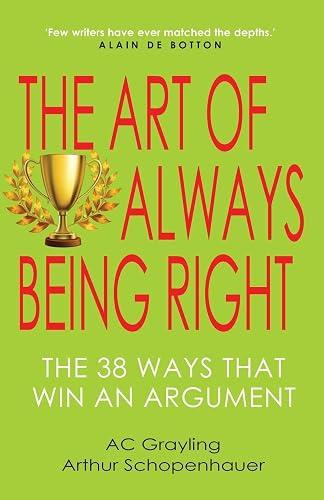
There is a peculiar frustration known to almost everyone: the experience of losing an argument you should have won. You had the facts. You had the logic. You had the evidence neatly arranged in your mind. And yet, somehow, your opponent walked away looking victorious while you stood there stammering, defeated not by reason but by something else entirely. This book exists because that experience is not an accident. It is the predictable result of a simple truth about human beings: we are not primarily reasoning creatures. We are creatures who use reason selectively, strategically, and often dishonestly, especially when our pride is at stake. The philosopher Arthur Schopenhauer understood this better than almost anyone. In the early nineteenth century, he wrote a small, sharp, and deeply cynical manual on argumentation that he called *Eristic Dialectic*, later published as *The Art of Always Being Right*. His central observation was uncomfortable but undeniable: in real arguments, truth is rarely the goal. Victory is the goal. Schopenhauer was not celebrating this fact. He was exposing it. He wanted readers to understand that most people, when engaged in a dispute, are not searching for the correct answer. They are searching for ways to appear correct. The distinction matters enormously. Consider what happens in a typical argument. Two people begin with opposing positions. In theory, they should examine the evidence, weigh the reasoning, and move toward the truth together. In practice, something very different occurs. Each person becomes invested in their position. Admitting error starts to feel like a personal failure. The argument transforms from a collaborative search for truth into a contest of wills, a battle for status, a performance for whatever audience happens to be watching. Once that transformation occurs, the rules change. Logic still matters, but only as one weapon among many. More important become the tools of rhetoric: framing, emotional appeal, distraction, misdirection, and the exploitation of the opponent's psychological weaknesses. The person who masters these tools can win arguments they should lose.…
Continue reading in the MinuteRead app
Get the complete 30-minute summary of The Art of Always Being Right
Get the complete summary in the appWinning arguments is about perception, not truth. Being right is not enough.
Vanity drives dishonest argumentation. People argue to protect their ego, not to find truth.
Framing shapes perception. Choose your words carefully. They determine how your argument is received.
Emotions persuade more than logic. Address feelings as well as facts.
Diversion is a common escape tactic. When losing, people change the subject. Do not follow.
Authority claims must be evaluated. Ask which authorities, what qualifications, what consensus.
"The Art of Always Being Right" is a strong fit if you want practical ideas around philosophy, self help, psychology, especially themes like winning arguments is about perception, not truth. being right is not enough; vanity drives dishonest argumentation. people argue to protect their ego, not to find truth. The MinuteRead summary distills these concepts into a focused read, whether you're deciding whether to buy the book or applying its lessons at work.
Motivated to help readers with "A man may be objectively in the right, A.C. Grayling wrote “The Art of Always Being Right” to package those ideas for a fast, focused read. In “The Art of Always Being Right”, A.C. Grayling focuses on "A man may be objectively in the right. Through “The Art of Always Being Right”, A.C. Grayling distills the core ideas on philosophy into lessons readers can absorb in a single short sitting. Readers turn to this work when they want A.C. Grayling's perspective on the…
Continue Reading
Access the complete 30-minute summary and thousands more nonfiction books in the MinuteRead app.

Continue reading the complete summary in the MinuteRead app.