MinuteRead
30 min
Book summary
Premium summary · Opens in the app · 30 min read
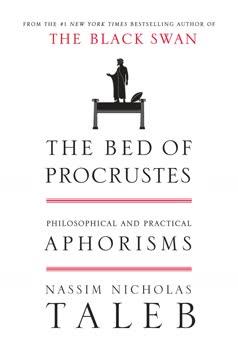
There is an ancient Greek myth about a man named Procrustes who ran an inn on the road to Athens. He had a bed, and he insisted that every guest fit it perfectly. If a traveler was too short, Procrustes stretched him on a rack until he matched the bed's dimensions. If a traveler was too tall, Procrustes cut off his legs. The bed was always right. The guest was always wrong.
**Author:** Nassim Nicholas Taleb
**Estimated Reading Time:** 45 minutes
**What You'll Learn:** Why our modern obsession with fitting reality into neat categories is making us fragile, how to embrace uncertainty as a source of strength, and why the most important knowledge often comes from knowing what to avoid rather than what to pursue.
**Who This Book Is For:** Anyone who senses that the modern world's promises of control, optimization, and certainty are hollow. Readers who want to think more clearly about risk, knowledge, and the good life without falling for the seductive oversimplifications that dominate contemporary discourse.
There is an ancient Greek myth about a man named Procrustes who ran an inn on the road to Athens. He had a bed, and he insisted that every guest fit it perfectly. If a traveler was too short, Procrustes stretched him on a rack until he matched the bed's dimensions. If a traveler was too tall, Procrustes cut off his legs. The bed was always right. The guest was always wrong. This myth, brutal and absurd as it is, captures something essential about how we think. We have a bed in our minds, a set of categories, theories, and expectations. When reality does not fit, we rarely question the bed. Instead, we stretch the facts, trim the anomalies, and force the world into shapes it was never meant to take. Nassim Nicholas Taleb wrote this book as a collection of aphorisms, each one a small rebellion against the Procrustean impulse. But beneath the sharp wit and the deliberate provocations lies a serious philosophical project. Taleb spent his career as a trader and researcher studying how systems respond to uncertainty. He watched brilliant people with sophisticated models blow up their portfolios because they confused their maps with the territory. He watched economists make confident predictions that failed spectacularly, only to return to the television studio the next day with new confident predictions. He watched institutions grow more fragile precisely because they believed they had eliminated risk. The problem, Taleb argues, is not that we lack information. The problem is that we have too much of the wrong kind of information and too little wisdom about what to do with it. We have built a world that rewards the appearance of knowledge over the reality of understanding. We celebrate people who sound certain while dismissing those who admit doubt. We optimize for efficiency while destroying the redundancy that makes systems resilient. We pursue happiness through comfort while making ourselves more fragile. This book is not a conventional self-help manual. It will not give you ten steps to a better life. It will not promise that positive thinking will solve your problems. Instead, it offers…
Continue reading in the MinuteRead app
Get the complete 30-minute summary of The Bed of Procrustes
Get the complete summary in the appYou cannot control your thoughts directly, but you can control your environment, and your environment shapes your though
Knowledge is subtractive. Focus on eliminating what is harmful rather than adding what seems beneficial.
Build antifragility by embracing small failures, maintaining optionality, and avoiding overoptimization.
Be skeptical of experts who lack skin in the game. Ask what happens to them if they are wrong.
The modern world makes us fragile through specialization, dependence, and addiction. Cultivate autonomy and resilience.
Philosophy is a practice, not a theory. Choose one virtue and practice it daily.
"The Bed of Procrustes" is a strong fit if you want practical ideas around philosophy, psychology, business, especially themes like you cannot control your thoughts directly, but you can control your environment, and your environment shapes your though; knowledge is subtractive. focus on eliminating what is harmful rather than adding what seems beneficial. The MinuteRead summary distills these concepts into a focused read, whether you're deciding whether to buy the book or applying its lessons at work.
Nassim Nicholas Taleb is a former risk trader turned researcher and author. He is best known for his multi-volume essay, the Incerto, which explores topics such as uncertainty, probability, and decision-making. Taleb has written numerous scholarly papers on risk and probability across various fields. He currently serves as Distinguished Professor of Risk Engineering at NYU's Tandon School of Engineering. Taleb's work focuses on systems that can handle disorder, which he terms "antifragile." He i…
View all summaries by Nassim Nicholas TalebContinue Reading
Access the complete 30-minute summary and thousands more nonfiction books in the MinuteRead app.

Continue reading the complete summary in the MinuteRead app.