MinuteRead
30 min
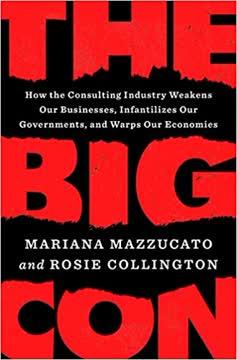
There is a strange paradox at the heart of modern government and business. Never before have organizations had access to so much advice, so many frameworks, so much strategic wisdom packaged and sold by brilliant people. And never before have so many large institutions seemed so incapable of doing difficult things well.
**Author:** Mariana Mazzucato
**Estimated Reading Time:** 45 minutes
**What You'll Learn:** How the consulting industry grew into one of the most powerful and least accountable forces in modern capitalism, why its influence often undermines the very organizations it claims to help, and what governments and businesses can do to rebuild genuine internal capability.
**Who This Book Is For:** Anyone who has wondered why governments spend billions on consultants yet seem less capable than ever, professionals who work alongside or within consulting firms, citizens concerned about how public money is spent, and leaders who want to understand the hidden costs of outsourcing expertise.
There is a strange paradox at the heart of modern government and business. Never before have organizations had access to so much advice, so many frameworks, so much strategic wisdom packaged and sold by brilliant people. And never before have so many large institutions seemed so incapable of doing difficult things well. The consulting industry has become one of the most remarkable commercial success stories of the past century. It has grown from a handful of small firms advising manufacturers on efficiency in the early 1900s into a global behemoth worth hundreds of billions of dollars annually. The largest firms now operate in nearly every country on earth. They advise presidents and prime ministers. They shape corporate strategy for the world's biggest companies. They help design public services, restructure economies, and craft responses to existential challenges like climate change. Yet alongside this extraordinary growth sits an uncomfortable question. What exactly are we getting for all this money? Mariana Mazzucato, one of the most influential economists of her generation, has spent years studying how value is created in modern economies. Her previous work challenged conventional wisdom about innovation, showing how the state, not the private sector, has often been the true engine behind transformative technologies. In The Big Con, she turns her attention to an industry that has positioned itself at the center of decision-making in both government and business, often without bearing any responsibility for the outcomes of its advice. The consulting industry, Mazzucato argues, is not simply a neutral provider of expertise. It is a powerful actor that has reshaped how organizations think, what they value, and what they are capable of doing. And in too many cases, that reshaping has made organizations weaker, not stronger. The problem is not that consultants are individually dishonest or incompetent. Many are highly intelligent, hardworking people who genuinely believe they are helping. The problem is structural. The consulting business model creates incentives that systematically undermine the long-term health of client organizations. It rewards the extraction of value rather than its creation. It encourages dependence rather than capability building. It allows…
Continue reading in the MinuteRead app
Get the complete 30-minute summary of The Big Con
Get the complete summary in the appThe consulting industry extracts value rather than creating it, charging fees that bear little relationship to the value
Consultants bear minimal risk for their advice, while clients bear the costs when projects fail.
The outsourcing of government functions has created an accountability gap that leaves the public with no clear answer to
Conflicts of interest are structural features of consulting, not occasional lapses that can be managed away.
Over-reliance on consultants hollows out organizational capability, creating a vicious cycle of dependence.
The choice to hire consultants is often a choice to rent expertise temporarily rather than build it permanently.
"The Big Con" is a strong fit if you want practical ideas around economics, business, politics, especially themes like the consulting industry extracts value rather than creating it, charging fees that bear little relationship to the value; consultants bear minimal risk for their advice, while clients bear the costs when projects fail. The MinuteRead summary distills these concepts into a focused read, whether you're deciding whether to buy the book or applying its lessons at work.
Mariana Mazzucato is a distinguished economist and professor at University College London, where she directs the Institute for Innovation and Public Purpose. Her research focuses on innovation economics and public value creation. Mazzucato has authored several best-selling books, including "The Entrepreneurial State" and "The Value of Everything." Her work has earned her numerous accolades, such as the 2020 John von Neumann Award and the 2018 Leontief Prize. She serves as Chair of the WHO's Coun…
View all summaries by Mariana MazzucatoContinue Reading
Access the complete 30-minute summary and thousands more nonfiction books in the MinuteRead app.

Continue reading the complete summary in the MinuteRead app.