MinuteRead
30 min
Book summary
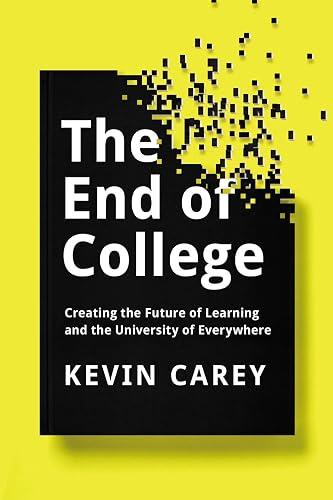
by Kevin Carey
Premium summary · Opens in the app · 30 min read
For generations, the American college has occupied a sacred place in the national imagination. It is the gateway to the middle class, the forge of character, the incubator of innovation, the place where young people become adults. Parents sacrifice for it. Students borrow heavily for it. Politicians champion it. Employers demand it. The college degree has become the single most important credential in American life, a prerequisite for economic security and social respectability.
**Author:** Kevin Carey
**Estimated Reading Time:** 45 minutes
**What You'll Learn:** How the modern university was built on a fragile hybrid of competing purposes, why it has failed to deliver on its promises, and how technology is creating an entirely new landscape of learning that will transform what it means to be educated.
**Who This Book Is For:** Students deciding whether college is worth the cost, parents navigating an increasingly complex educational landscape, educators questioning the status quo, policymakers seeking reform, and anyone curious about how technology will reshape one of society's most entrenched institutions.
For generations, the American college has occupied a sacred place in the national imagination. It is the gateway to the middle class, the forge of character, the incubator of innovation, the place where young people become adults. Parents sacrifice for it. Students borrow heavily for it. Politicians champion it. Employers demand it. The college degree has become the single most important credential in American life, a prerequisite for economic security and social respectability. Yet beneath this reverence lies an uncomfortable truth. The modern American university, for all its grandeur and prestige, is failing at its most fundamental task: educating people. The evidence is difficult to ignore. College tuition has tripled since the 1980s, far outpacing inflation and family income. Student debt now exceeds one trillion dollars, a burden that prevents young people from buying homes, starting families, and building financial security. Meanwhile, graduation rates remain stubbornly low. Less than two-thirds of students who enroll in a four-year college manage to finish within six years. At community colleges, the numbers are far worse. But even those who graduate often leave without having learned very much. A landmark study of American higher education found that large proportions of students demonstrate no significant improvement in critical thinking, complex reasoning, or writing skills during their college years. Many graduates cannot perform basic tasks of literacy and numeracy. They have paid dearly for a credential that signals very little about what they actually know or can do. This is not a new problem. The structural flaws in American higher education have been visible for more than a century. Critics from William James to Jacques Barzun have pointed out the fundamental incoherence at the heart of the modern university. The institution was never designed to educate undergraduates effectively. It was assembled from competing purposes and conflicting priorities, held together by historical accident and institutional inertia. The American university emerged in the late nineteenth century as a hybrid of three very different ideas. From the land-grant movement came the goal of practical training, preparing students for useful work in agriculture, engineering, and industry. From Germany came the research ideal, the notion that…
Continue reading in the MinuteRead app
Get the complete 30-minute summary of The End of College
Get the complete summary in the appThe modern American university is a historical accident, assembled from competing purposes that do not naturally fit tog
The research ideal dominates faculty incentives, leaving teaching systematically undervalued and undergraduate education
College costs have risen dramatically while learning outcomes have remained stagnant or declined.
Learning is an active process of constructing knowledge, and effective education requires individualization.
Computers can process information, not just transmit it, which makes them fundamentally different from earlier education
The internet changed the economics of information, making the transmission of knowledge nearly free and enabling the unb
"The End of College" is a strong fit if you want practical ideas around education, history, economics, especially themes like the modern american university is a historical accident, assembled from competing purposes that do not naturally fit tog; the research ideal dominates faculty incentives, leaving teaching systematically undervalued and undergraduate education. The MinuteRead summary distills these concepts into a focused read, whether you're deciding whether to buy the book or applying its lessons at work.
Motivated to help readers with “American higher education, Kevin Carey wrote “The End of College” to package those ideas for a fast, focused read. In “The End of College”, Kevin Carey focuses on “American higher education. Through “The End of College”, Kevin Carey distills the core ideas on education into lessons readers can absorb in a single short sitting. Readers turn to this work when they want Kevin Carey's perspective on the subject without working through the entire original volume. The E…
Continue Reading
Access the complete 30-minute summary and thousands more nonfiction books in the MinuteRead app.

Continue reading the complete summary in the MinuteRead app.