MinuteRead
30 min
Book summary
Premium summary · Opens in the app · 30 min read
There is a strange paradox at the heart of the modern global economy. Every year, the world's governments publish detailed statistics about trade flows, investment patterns, and financial activity. International organizations track everything from carbon emissions to container shipments with remarkable precision. Central banks monitor money creation down to the decimal point. And yet, when it comes to one of the most important questions in economics, the answer remains shrouded in mystery: where
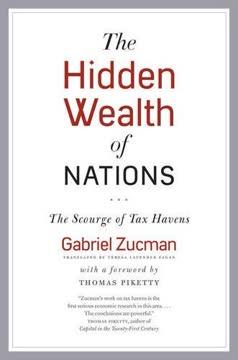
**Author:** Gabriel Zucman
**Estimated Reading Time:** 45 minutes
**What You'll Learn:**
- Why trillions of dollars in private wealth exist beyond the reach of any tax authority - How a handful of small jurisdictions became the guardians of global financial secrecy - What tax havens actually cost governments, citizens, and democracies every year - Why previous attempts to crack down on offshore finance have failed so completely - What practical solutions could actually work, and what stands in their way
**Who This Book Is For:**
This book is for anyone who has ever wondered why the wealthiest individuals and largest corporations seem to play by different rules. It is for citizens who suspect that the tax system is rigged but cannot quite explain how. It is for policymakers, students, journalists, and concerned readers who want to understand the hidden architecture of global finance. If you have ever felt that something is deeply wrong with how wealth is taxed, this book will show you exactly what that something is, how big it is, and what can be done about it.
There is a strange paradox at the heart of the modern global economy. Every year, the world's governments publish detailed statistics about trade flows, investment patterns, and financial activity. International organizations track everything from carbon emissions to container shipments with remarkable precision. Central banks monitor money creation down to the decimal point. And yet, when it comes to one of the most important questions in economics, the answer remains shrouded in mystery: where is the world's wealth actually held? The uncomfortable truth is that a significant portion of the planet's financial assets has simply vanished from official view. Not stolen, not destroyed, but hidden. Hidden in plain sight, through a sophisticated network of jurisdictions, legal structures, and financial instruments designed to make wealth invisible to the governments that might want to tax it. Gabriel Zucman, a French economist who has become one of the world's leading authorities on tax havens and wealth inequality, set out to answer a deceptively simple question: how much wealth is hidden offshore, and what does that hidden wealth cost the rest of us? The answer, as he documents in meticulous detail, is staggering. Around 8 percent of the world's household financial wealth, roughly $7.6 trillion at the time of his research, is held in tax havens. This is not a marginal phenomenon affecting a handful of billionaires. It is a structural feature of the global economy that touches every country, every government budget, and every citizen who pays their taxes honestly. The problem Zucman identifies goes far beyond simple tax evasion. Tax havens are not merely a nuisance or an irritant at the edges of the…
Continue reading in the MinuteRead app
Get the complete 30-minute summary of The Hidden Wealth of Nations
Get the complete summary in the appEight percent of global household financial wealth, or $7.6 trillion, is held in tax havens, beyond the reach of any tax
Tax evasion through offshore accounts costs governments about $200 billion annually in lost revenue.
Switzerland pioneered the tax haven model in the 1920s and 1930s, using banking secrecy to attract foreign capital seeki
Multinational corporations use tax havens to shift profits, with US firms alone avoiding about $130 billion in taxes ann
Previous reforms have failed because they were designed to fail, lacking enforcement mechanisms and containing loopholes
Automatic information exchange, backed by real sanctions, is the most effective tool for combating tax evasion, as demon
"The Hidden Wealth of Nations" is a strong fit if you want practical ideas around economics, politics, finance, especially themes like eight percent of global household financial wealth, or $7.6 trillion, is held in tax havens, beyond the reach of any tax; tax evasion through offshore accounts costs governments about $200 billion annually in lost revenue. The MinuteRead summary distills these concepts into a focused read, whether you're deciding whether to buy the book or applying its lessons at work.
Gabriel Zucman is a French economist known for his research on wealth inequality and tax havens. He completed his PhD under Thomas Piketty at the Paris School of Economics and is now a professor at the University of California, Berkeley. Zucman's work focuses on measuring hidden wealth and estimating the scale of tax evasion by corporations and wealthy individuals. He has gained recognition for developing innovative methods to analyze global financial data and propose policy solutions to address…
View all summaries by Gabriel ZucmanContinue Reading
Access the complete 30-minute summary and thousands more nonfiction books in the MinuteRead app.

Continue reading the complete summary in the MinuteRead app.