MinuteRead
30 min
Book summary
Premium summary · Opens in the app · 30 min read
For most of the twentieth century, America's economic geography followed a predictable pattern. Poor regions were catching up with rich ones. Manufacturing jobs spread prosperity across the country. A worker in Mississippi could reasonably expect that their children would have better opportunities than they did, and that their community would grow more prosperous over time.
**Author:** Enrico Moretti **Estimated Reading Time:** 45 minutes
**What You'll Learn:**
- Why some American cities are thriving while others are collapsing - How innovation hubs create prosperity that extends far beyond tech workers - Why where you live now matters more than ever for your economic future - What the Great Divergence means for your career, your community, and your country - How education, mobility, and immigration shape the new economic map
**Who This Book Is For:**
Anyone who has wondered why opportunity seems concentrated in a handful of cities. Anyone who has considered moving for work. Anyone who wants to understand the forces reshaping American prosperity. This book is for people who sense that the old rules no longer apply and want to know what replaced them.
For most of the twentieth century, America's economic geography followed a predictable pattern. Poor regions were catching up with rich ones. Manufacturing jobs spread prosperity across the country. A worker in Mississippi could reasonably expect that their children would have better opportunities than they did, and that their community would grow more prosperous over time. That world is gone. Over the past three decades, a quiet revolution has transformed the American economy. The forces that once pushed communities toward convergence have reversed. Today, the gap between America's most prosperous cities and its struggling ones is wider than at any point in recent history. Some communities are booming, attracting talent and investment from around the world. Others are hollowing out, losing their most ambitious young people and watching their economic base erode. Enrico Moretti, an economist at the University of California, Berkeley, calls this phenomenon the Great Divergence. It is not simply a story about rich and poor. It is a story about how the nature of work itself has changed, and how that change has rewritten the rules of economic geography. The old economy was built on physical capital: factories, machines, raw materials. These things could be located almost anywhere. A textile mill could operate in North Carolina or Massachusetts or Mississippi. What mattered was access to transportation, cheap land, and a willing workforce. This meant that communities across the country could compete for jobs, and many succeeded. The new economy is built on human capital: knowledge, creativity, and innovation. These things are not evenly distributed. They cluster. They concentrate in specific places for specific reasons. And once they concentrate, they tend to stay concentrated, creating self-reinforcing cycles of success that are extraordinarily difficult for other communities to replicate. This shift has profound implications. It affects where jobs are created, who gets them, and how much they pay. It affects housing prices, school quality, crime rates, and life expectancy. It affects…
Continue reading in the MinuteRead app
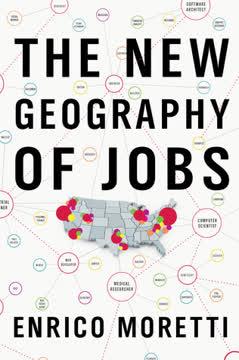
Get the complete 30-minute summary of The New Geography Of Jobs
Get the complete summary in the appAmerica's economic map is becoming increasingly uneven, with prosperity concentrated in a handful of innovation hubs.
Innovation hubs are characterized by high concentrations of skilled workers, research universities, venture capital, and
Each high-tech job creates about five additional local jobs through the multiplier effect.
Three forces drive clustering: thick labor markets, specialized service providers, and knowledge spillovers.
Education is strongly correlated with geographic mobility, and this relationship exacerbates economic inequality.
Revitalizing struggling communities is extraordinarily difficult because the forces driving the Great Divergence are sel
"The New Geography Of Jobs" is a strong fit if you want practical ideas around economics, business, politics, especially themes like america's economic map is becoming increasingly uneven, with prosperity concentrated in a handful of innovation hubs; innovation hubs are characterized by high concentrations of skilled workers, research universities, venture capital, and. The MinuteRead summary distills these concepts into a focused read, whether you're deciding whether to buy the book or applying its lessons at work.
Enrico Moretti is an economics professor at the University of California, Berkeley. His research focuses on labor economics, urban economics, and economic geography. Moretti's work has gained recognition from prestigious institutions, receiving support from the National Science Foundation and the National Institutes of Health. His expertise has been featured in prominent publications such as the New York Times and the Wall Street Journal. Moretti's research contributes to understanding the dynam…
View all summaries by Enrico MorettiContinue Reading
Access the complete 30-minute summary and thousands more nonfiction books in the MinuteRead app.

Continue reading the complete summary in the MinuteRead app.