MinuteRead
30 min
Book summary
Premium summary · Opens in the app · 30 min read
There is a moment in every society when the gap between the rich and everyone else stops being a statistic and starts being a threat. The United States passed that moment some time ago.
**Author:** Joseph E. Stiglitz
**Estimated Reading Time:** 45 minutes
**What You'll Learn:** How extreme inequality undermines economic efficiency, destabilizes democracy, and erodes the foundations of a healthy society. You will understand the mechanisms through which the wealthy shape policy, why markets alone cannot explain the current distribution of wealth, and what structural reforms could create a more equitable and productive economy.
**Who This Book Is For:** Anyone who senses that the economic game is rigged but wants a rigorous, evidence-based explanation of how and why. Readers interested in economics, public policy, democracy, and social justice will find a clear framework for understanding one of the defining challenges of our time.
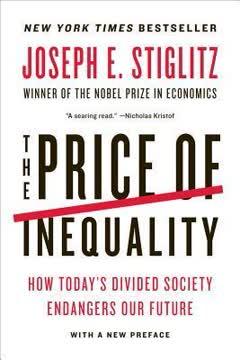
There is a moment in every society when the gap between the rich and everyone else stops being a statistic and starts being a threat. The United States passed that moment some time ago. Joseph Stiglitz wrote *The Price of Inequality* not as an academic exercise but as a warning. A Nobel Prize-winning economist who served as chief economist of the World Bank and chaired the Council of Economic Advisers under President Clinton, Stiglitz had a front-row seat to the transformation of the American economy. What he witnessed disturbed him deeply: a system increasingly organized to benefit a tiny fraction of the population at the expense of everyone else. The numbers tell part of the story. The top 1 percent of Americans now control more wealth than the bottom 90 percent combined. The richest four hundred Americans have more wealth than the bottom 150 million. But Stiglitz is not primarily interested in the numbers. He is interested in the mechanisms. How did this happen? Who designed the rules? And what are the consequences for a society that prides itself on being a land of opportunity? The conventional wisdom holds that inequality is the inevitable byproduct of market forces. Technology has rewarded the skilled. Globalization has punished the unskilled. Education has failed to keep pace. In this telling, inequality is unfortunate but natural, the price we pay for dynamism and innovation. Stiglitz rejects this story. He argues that inequality is not primarily the result of impersonal market forces. It is the result of political choices. The rules of the game have been written by those who benefit most from them. Tax codes favor capital over labor. Financial regulations protect banks from the consequences of their own recklessness. Trade agreements protect corporate interests while exposing workers to brutal competition. Labor laws have been systematically weakened. The result is not a meritocracy but a system of rent-seeking, where the wealthy extract value from the economy rather than create it. This distinction matters enormously. If inequality were simply the natural outcome of market forces,…
Continue reading in the MinuteRead app
Get the complete 30-minute summary of The Price of Inequality
Get the complete summary in the appInequality is not primarily the result of market forces but of political choices.
The wealthy shape policy through rent-seeking, extracting wealth rather than creating it.
The financial sector has grown too large and too disconnected from the real economy.
Globalization has been managed to protect corporate interests while exposing workers to competition.
The American dream is increasingly a myth, with lower social mobility than many other developed countries.
Monetary policy has distributional consequences that favor the wealthy.
"The Price of Inequality" is a strong fit if you want practical ideas around economics, politics, sociology, especially themes like inequality is not primarily the result of market forces but of political choices; the wealthy shape policy through rent-seeking, extracting wealth rather than creating it. The MinuteRead summary distills these concepts into a focused read, whether you're deciding whether to buy the book or applying its lessons at work.
Joseph Eugene Stiglitz is a renowned American economist and Columbia University professor. He won the Nobel Memorial Prize in Economic Sciences in 2001 and the John Bates Clark Medal in 1979. Stiglitz served as Senior Vice President and Chief Economist of the World Bank and is known for his critical views on globalization management and free-market economics. He founded the Initiative for Policy Dialogue and holds positions at various institutions worldwide. Stiglitz is highly cited in economics…
View all summaries by Joseph E. StiglitzContinue Reading
Access the complete 30-minute summary and thousands more nonfiction books in the MinuteRead app.

Continue reading the complete summary in the MinuteRead app.