MinuteRead
30 min
Book summary
Premium summary · Opens in the app · 30 min read
For decades, the world has approached poverty alleviation with remarkable generosity and disappointing results. Trillions of dollars have flowed from wealthy nations to developing economies through aid programs, infrastructure projects, institutional reforms, and anti-corruption initiatives. Yet despite these efforts, more than two billion people still live on less than three dollars a day. Something fundamental is missing from our approach.
**Author:** Clayton M. Christensen **Estimated Reading Time:** 45 minutes
**What You'll Learn:** - Why traditional development efforts often fail despite billions in investment - How market-creating innovations generate lasting prosperity - The surprising relationship between innovation and institutional development - Why corruption diminishes when new markets emerge - Practical frameworks for identifying and seizing nonconsumption opportunities
**Who This Book Is For:** Entrepreneurs seeking untapped markets, policymakers frustrated with stagnant development programs, investors looking for transformative opportunities, and anyone curious about why some nations prosper while others remain trapped in poverty despite abundant resources and good intentions.
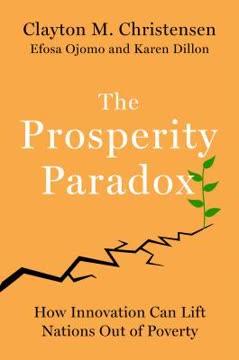
For decades, the world has approached poverty alleviation with remarkable generosity and disappointing results. Trillions of dollars have flowed from wealthy nations to developing economies through aid programs, infrastructure projects, institutional reforms, and anti-corruption initiatives. Yet despite these efforts, more than two billion people still live on less than three dollars a day. Something fundamental is missing from our approach. Clayton Christensen, the renowned Harvard Business School professor who transformed how we think about innovation, spent years studying why some companies succeed while others fail. Late in his career, he began asking a different question: Could the same principles that explain business success also explain national prosperity? The answer, he discovered, was not only yes but profoundly yes. The Prosperity Paradox emerged from this investigation. Christensen and his co-authors, Efosa Ojomo and Karen Dillon, spent years examining development efforts across Africa, Asia, and Latin America. They studied successes and failures, interviewed entrepreneurs and policymakers, and analyzed decades of economic data. What they found challenges conventional wisdom about how prosperity is created. The central problem, they argue, is that most development efforts focus on the symptoms of poverty rather than its root cause. We build schools, hospitals, roads, and power plants. We train workers and reform institutions. We fight corruption and improve governance. All of these are worthwhile. But none of them, on their own, create prosperity. Prosperity, Christensen discovered, is a process. It emerges when innovations create new markets that serve people who previously could not access or afford existing solutions. These market-creating innovations generate jobs, build infrastructure, strengthen institutions, and gradually transform entire societies. They pull development into existence rather than pushing it from outside. Consider the difference between two approaches to bringing clean water to a village. A traditional development program might drill a well, install a pump, and train a local committee to maintain it. The well works for a while, then breaks. The committee lacks funds for repairs. The pump rusts. Within a few years, the village is back to fetching water from a contaminated river. This is a push strategy, and it fails because no market exists to sustain…
Continue reading in the MinuteRead app
Get the complete 30-minute summary of The Prosperity Paradox
Get the complete summary in the appProsperity is created through market-creating innovations that serve nonconsumers.
Nonconsumption represents enormous untapped market opportunity in developing countries.
Pull strategies outperform push strategies because they align incentives around genuine demand.
Innovation precedes institutions. Markets pull in the institutions they need.
Corruption diminishes when legitimate economic opportunities expand.
Emergent strategy is essential for navigating the uncertainty of market creation.
"The Prosperity Paradox" is a strong fit if you want practical ideas around economics, business, politics, especially themes like prosperity is created through market-creating innovations that serve nonconsumers; nonconsumption represents enormous untapped market opportunity in developing countries. The MinuteRead summary distills these concepts into a focused read, whether you're deciding whether to buy the book or applying its lessons at work.
Clayton M. Christensen is a renowned business professor at Harvard Business School, best known for his work on disruptive innovation. Born in Salt Lake City, Utah, he holds degrees from Brigham Young University, Oxford University, and Harvard Business School. Christensen has authored several influential books, including "The Innovator's Dilemma." He is a member of The Church of Jesus Christ of Latter-day Saints and has served in various leadership positions within the church. Christensen speaks …
View all summaries by Clayton M. ChristensenContinue Reading
Access the complete 30-minute summary and thousands more nonfiction books in the MinuteRead app.

Continue reading the complete summary in the MinuteRead app.