MinuteRead
30 min
Book summary
Premium summary · Opens in the app · 30 min read
Every political movement claims to stand for freedom. Every economic ideology promises to deliver it. Yet few words in public life are more abused, more selectively invoked, and more poorly understood. The result is a paradox: societies that loudly proclaim their devotion to freedom often produce citizens who feel trapped, powerless, and anything but free.
**Author:** Joseph E. Stiglitz
**Estimated Reading Time:** 45 minutes
**What You'll Learn:** Why the conventional understanding of freedom is dangerously incomplete, how economic systems either expand or restrict genuine human freedom, and what a more honest and workable vision of freedom requires.
**Who This Book Is For:** Readers who sense that something is wrong with the way freedom is discussed in politics and economics, who want to understand the hidden trade-offs behind every claim of liberty, and who are looking for a coherent alternative to the failed promises of market fundamentalism.
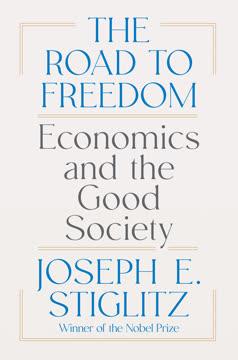
Every political movement claims to stand for freedom. Every economic ideology promises to deliver it. Yet few words in public life are more abused, more selectively invoked, and more poorly understood. The result is a paradox: societies that loudly proclaim their devotion to freedom often produce citizens who feel trapped, powerless, and anything but free. Joseph Stiglitz, one of the most influential economists of his generation, wrote *The Road to Freedom* to confront this paradox directly. His central observation is uncomfortable but unavoidable. Freedom is not a simple, self-evident concept. It is contested, complex, and full of hidden trade-offs. When we ignore those trade-offs, we end up with policies that expand freedom for a few while quietly destroying it for many. The problem begins with a seductive but deeply flawed story. According to this story, freedom means the absence of government interference. Markets are the natural domain of liberty. Individuals left to pursue their own interests will generate prosperity and opportunity for all. Government is at best a necessary evil, at worst a threat to everything that matters. This story has dominated economic and political thinking for decades. It is known as neoliberalism, and Stiglitz argues that its failures are now impossible to ignore. Consider the evidence. The era of neoliberal dominance has produced staggering levels of inequality. In the United States, a handful of billionaires now control more wealth than the bottom half of the population combined. Financial crises have become more frequent and more severe, wiping out the savings of ordinary families while bankers walk away with bonuses. Environmental degradation has accelerated, threatening the very conditions that make life and liberty possible. Social trust has eroded, communities have fractured, and democratic institutions have been captured by moneyed interests. None of this looks like freedom. Yet the language of freedom was used to justify every step along the way. Deregulation was sold as liberation. Tax cuts for the wealthy were framed as letting people keep what they earn. The weakening of labor protections was presented as flexibility and choice. The result was not a society of free individuals but a society where the powerful were freed from constraint…
Continue reading in the MinuteRead app
Get the complete 30-minute summary of The Road to Freedom
Get the complete summary in the appFreedom involves trade-offs. One person's freedom is often another's unfreedom.
Externalities are pervasive. Markets do not automatically account for the costs and benefits that actions impose on othe
Coercion can enhance freedom. Public goods and coordination problems require collective action.
The social contract defines the baseline conditions of freedom. It must evolve to meet changing circumstances.
Market incomes often lack moral legitimacy. Wealth is shaped by luck, power, and historical injustice.
Exploitation undermines freedom and efficiency. Regulation is necessary to protect the vulnerable.
"The Road to Freedom" is a strong fit if you want practical ideas around economics, politics, business, especially themes like freedom involves trade-offs. one person's freedom is often another's unfreedom; externalities are pervasive. markets do not automatically account for the costs and benefits that actions impose on othe. The MinuteRead summary distills these concepts into a focused read, whether you're deciding whether to buy the book or applying its lessons at work.
Joseph Eugene Stiglitz is a renowned American economist and professor at Columbia University. He won the Nobel Memorial Prize in Economic Sciences in 2001 and the John Bates Clark Medal in 1979. Stiglitz has held prominent positions, including Senior Vice President and Chief Economist of the World Bank. Known for his critical views on globalization and free-market fundamentalism, he founded the Initiative for Policy Dialogue in 2000. Stiglitz is a highly cited economist and holds professorships …
View all summaries by Joseph E. StiglitzContinue Reading
Access the complete 30-minute summary and thousands more nonfiction books in the MinuteRead app.

Continue reading the complete summary in the MinuteRead app.