MinuteRead
30 min
Book summary
by Matt Miller
Premium summary · Opens in the app · 30 min read
America has a strange problem. The country possesses enormous wealth, extraordinary innovation, and a political system that has endured for more than two centuries. Yet on issue after issue, from health care to education to poverty, the nation seems stuck. Politicians argue endlessly. Pundits shout past each other. Citizens grow cynical. And the problems remain.
**Author:** Matt Miller
**Estimated Reading Time:** 45 minutes
**What You'll Learn:**
- Why a modest reallocation of just two percent of America's GDP could solve the nation's most stubborn domestic problems - How universal health coverage can be achieved without a government takeover - Why paying teachers dramatically more in poor schools could transform education - How to ensure a living wage without burdening employers - What "Patriot Dollars" could do to fix campaign finance - Why entitlement reform is urgent and how to do it fairly - How citizens can build the political will for ambitious change
**Who This Book Is For:**
This book is for anyone frustrated by political gridlock and convinced that America's biggest problems have become unsolvable. It is for readers who suspect that both parties are trapped in outdated ideological positions and who want to understand what practical solutions might actually look like. If you have ever wondered whether there is a middle path between big government liberalism and laissez-faire conservatism, this book offers a compelling answer.
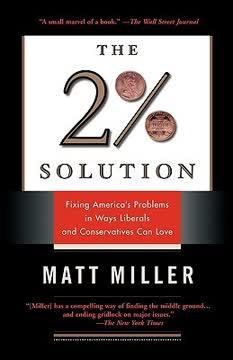
America has a strange problem. The country possesses enormous wealth, extraordinary innovation, and a political system that has endured for more than two centuries. Yet on issue after issue, from health care to education to poverty, the nation seems stuck. Politicians argue endlessly. Pundits shout past each other. Citizens grow cynical. And the problems remain. Matt Miller wrote *The Two Percent Solution* to address this paralysis. His starting point is simple but provocative: the United States does not lack the resources to solve its biggest domestic challenges. It lacks the imagination and political will to use those resources differently. The money is already there. It is simply being spent on the wrong things, or spent inefficiently, or trapped in programs designed for a different era. Consider the scale of the problem. Tens of millions of Americans lack health insurance. Public schools in poor neighborhoods fail generation after generation of children. Millions of full-time workers earn wages too low to lift a family out of poverty. Campaign finance has turned democracy into a contest between wealthy donors rather than citizens. And looming over all of this is the demographic reality of the baby boom generation's retirement, which threatens to overwhelm the federal budget. These are not small problems. They are structural, deeply rooted, and interconnected. They have defeated generations of reformers. Yet Miller argues that a solution exists, and it is surprisingly affordable. The core insight of *The Two Percent Solution* is that redirecting just two percent of America's gross domestic product, roughly $220 billion annually at the time of the book's publication, could fund universal health coverage, dramatically improve education in low-income areas, ensure a living wage for…
Continue reading in the MinuteRead app
Get the complete 30-minute summary of The Two Percent Solution
Get the complete summary in the appTwo percent of America's GDP, about $220 billion annually, could solve the nation's most pressing domestic problems.
Universal health coverage can be achieved through tax credits and community rating, without a government takeover.
Raising teacher pay in low-income schools by 50 percent would transform education by attracting top talent.
A wage subsidy would ensure a living wage for full-time workers without burdening employers.
Patriot Dollars would give every voter $50 to support political candidates, offsetting the influence of big money.
Entitlement reform is urgent. Shifting to price indexing for Social Security and premium support for Medicare would ensu
"The Two Percent Solution" is a strong fit if you want practical ideas around economics, politics, especially themes like two percent of america's gdp, about $220 billion annually, could solve the nation's most pressing domestic problems; universal health coverage can be achieved through tax credits and community rating, without a government takeover. The MinuteRead summary distills these concepts into a focused read, whether you're deciding whether to buy the book or applying its lessons at work.
Matthew Miller is a multifaceted media personality and policy expert. He contributes to various platforms, including syndicated columns, NPR's Morning Edition, and the radio program Left, Right & Center. Miller's writing has been featured in prestigious publications like the Atlantic Monthly, the New Republic, and the New York Times Magazine. His professional background includes serving as a senior adviser in the White House Office of Management and Budget and working as a management consultant …
View all summaries by Matt MillerContinue Reading
Access the complete 30-minute summary and thousands more nonfiction books in the MinuteRead app.

Continue reading the complete summary in the MinuteRead app.