MinuteRead
30 min
Book summary
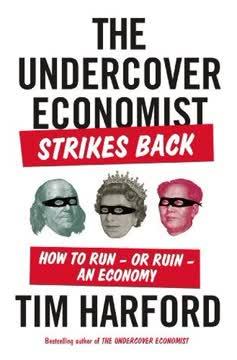
by Tim Harford
Premium summary · Opens in the app · 30 min read
Imagine trying to understand how a car works by only looking at the speedometer. You could tell when the car was moving fast or slow, but you would have no idea why. You would not know whether the engine was overheating, whether the fuel was running low, or whether the road ahead was smooth or full of potholes.
**Author:** Tim Harford
**Estimated Reading Time:** 45 minutes
**What You'll Learn:**
- Why GDP fails to measure what truly matters in an economy - How a babysitting co-op explained the Great Depression - What a prisoner-of-war camp reveals about money and markets - Why recessions happen and how policymakers actually fight them - The hidden role of management quality in national prosperity - How inequality shifts across nations and within them - Why macroeconomics needs to change if it wants to remain relevant
**Who This Book Is For:**
Anyone who has ever wondered why economies boom and bust, whether government stimulus actually works, or what central bankers really do all day. If you want to understand the forces shaping your job, your paycheck, and your country's future, this book is your guide.
Imagine trying to understand how a car works by only looking at the speedometer. You could tell when the car was moving fast or slow, but you would have no idea why. You would not know whether the engine was overheating, whether the fuel was running low, or whether the road ahead was smooth or full of potholes. This is roughly how most of us experience the economy. We hear numbers on the news: GDP growth, unemployment rates, inflation figures. We know these numbers matter. We sense that they affect our lives in profound ways. But we rarely understand what lies beneath them. Tim Harford wrote The Undercover Economist Strikes Back to change that. His goal is ambitious: to explain how macroeconomics, the study of entire economies, actually works. Not through abstract equations or dense academic prose, but through stories, thought experiments, and real-world examples that make the invisible machinery of economic life visible. The book begins with a deceptively simple question: what makes an economy grow? The answer, it turns out, is not as straightforward as you might think. Economists have been arguing about it for centuries, and their debates have real consequences. When a recession hits, millions of people lose jobs. When policymakers make the wrong call, the suffering deepens. When they get it right, recovery comes faster. But here is the problem. Macroeconomics is hard. Unlike a chemist who can run controlled experiments in a laboratory, an economist cannot deliberately crash a national economy just to see what happens. The stakes are too high, the variables too numerous, and the opportunities for clean observation too rare. So economists have developed other tools. They build models, simplified versions of reality that capture essential relationships while ignoring irrelevant details. They study natural experiments, situations where real-world events approximate laboratory conditions. And they draw lessons from unexpected places: babysitting cooperatives, prisoner-of-war camps, and the management practices of textile…
Continue reading in the MinuteRead app
Get the complete 30-minute summary of The Undercover Economist Strikes Back
Get the complete summary in the appGDP is a valuable but incomplete measure of economic success. It omits environmental costs, unpaid work, inequality, and
Recessions can be caused by insufficient demand or disrupted supply. Correctly diagnosing the cause is essential for eff
Money emerges naturally to solve the problem of trade. The money supply affects prices: too much causes inflation, too l
Central banks manage the economy by setting interest rates and controlling the money supply. Their power is real but lim
Fiscal stimulus can boost demand during recessions, but timing and targeting matter. Delayed or poorly targeted stimulus
Unemployment has multiple causes. Cyclical unemployment responds to stimulus; structural unemployment requires education
"The Undercover Economist Strikes Back" is a strong fit if you want practical ideas around economics, business, finance, especially themes like gdp is a valuable but incomplete measure of economic success. it omits environmental costs, unpaid work, inequality, and; recessions can be caused by insufficient demand or disrupted supply. correctly diagnosing the cause is essential for eff. The MinuteRead summary distills these concepts into a focused read, whether you're deciding whether to buy the book or applying its lessons at work.
Tim Harford is a prominent economist and writer known for his ability to explain complex economic concepts in an accessible manner. He serves on the Financial Times editorial board and writes the popular "The Undercover Economist" column, which is syndicated worldwide. Harford is unique in running an economics-based problem page called "Dear Economist" where he applies economic theory to readers' personal issues. His writing style is characterized by its wit, clarity, and use of everyday experie…
View all summaries by Tim HarfordContinue Reading
Access the complete 30-minute summary and thousands more nonfiction books in the MinuteRead app.

Continue reading the complete summary in the MinuteRead app.