MinuteRead
30 min
Book summary
Premium summary · Opens in the app · 30 min read
Why are some nations rich and others poor? The question seems simple, yet it has puzzled economists, historians, and political leaders for centuries. The gap between the wealthiest and poorest countries on earth is not merely large. It is staggering, and it has been widening for hundreds of years. A child born in Switzerland inherits a world of opportunity that a child born in Chad can scarcely imagine. The difference is not a matter of individual effort or moral worth. It is the product of deep
**Author:** David S. Landes
**Estimated Reading Time:** 45 minutes
**What You'll Learn:** Why some nations became wealthy while others remained poor, how geography and climate shaped economic destiny, what made Europe's rise unique, why the Industrial Revolution transformed global power, and how institutions, culture, and technology determine whether societies prosper or stagnate.
**Who This Book Is For:** Readers who want to understand the deep historical forces behind global inequality, anyone curious about why economic development has been so uneven across nations, and those seeking a richer perspective on the relationship between culture, geography, and prosperity.
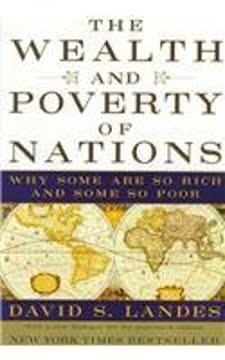
Why are some nations rich and others poor? The question seems simple, yet it has puzzled economists, historians, and political leaders for centuries. The gap between the wealthiest and poorest countries on earth is not merely large. It is staggering, and it has been widening for hundreds of years. A child born in Switzerland inherits a world of opportunity that a child born in Chad can scarcely imagine. The difference is not a matter of individual effort or moral worth. It is the product of deep historical forces that have shaped the destinies of entire civilizations. David S. Landes spent his career trying to explain this divergence. As one of the most respected economic historians of the twentieth century, he taught at Harvard and George Washington University, and his work influenced generations of scholars. In The Wealth and Poverty of Nations, Landes offers a sweeping account of world economic history, from ancient China to the Industrial Revolution to the modern era. His central argument is both simple and controversial: the world has never been a level playing field, and everything costs. Landes rejected the comfortable notion that all nations have equal potential and that poverty is simply the result of exploitation or bad luck. Instead, he argued that geography, climate, culture, institutions, and technology all play decisive roles in determining economic outcomes. Some places are naturally more favorable to human flourishing than others. Some societies develop values and institutions that encourage innovation, hard work, and enterprise. Others do not. The consequences of these differences accumulate over centuries, producing the vast inequalities we see today. This book was controversial when it appeared in 1998, and it remains controversial now. Landes was unapologetically Eurocentric, arguing that explaining Europe's economic success requires acknowledging that Europe did something remarkable. He was criticized for cultural bias, for celebrating Western values while dismissing other civilizations. Yet even his critics acknowledged the breadth of his scholarship and the power of his narrative. Landes did not claim that Europeans were inherently superior. He claimed that Europe developed a particular set of institutions, values, and practices that happened to be extraordinarily conducive to economic…
Continue reading in the MinuteRead app
Get the complete 30-minute summary of The Wealth and Poverty of Nations
Get the complete summary in the appGeography shapes economic potential but does not determine destiny.
Europe's political fragmentation drove innovation through competition.
The Industrial Revolution created unprecedented wealth and global inequality.
Institutions that protect property rights and reward merit are essential for prosperity.
Intellectual freedom is necessary for technological advancement.
Intolerance imposes economic costs on the persecutor.
"The Wealth and Poverty of Nations" is a strong fit if you want practical ideas around economics, history, politics, especially themes like geography shapes economic potential but does not determine destiny; europe's political fragmentation drove innovation through competition. The MinuteRead summary distills these concepts into a focused read, whether you're deciding whether to buy the book or applying its lessons at work.
David S. Landes was a renowned economic historian who taught at Harvard and George Washington University. He authored several influential books on economic history, including "The Wealth and Poverty of Nations." Landes was known for his detailed historical narratives and controversial arguments about the reasons for economic disparities between nations. He embraced a Eurocentric perspective, arguing that explaining Europe's economic success necessitated such an approach. Landes's work received b…
View all summaries by David S. LandesContinue Reading
Access the complete 30-minute summary and thousands more nonfiction books in the MinuteRead app.

Continue reading the complete summary in the MinuteRead app.