MinuteRead
30 min
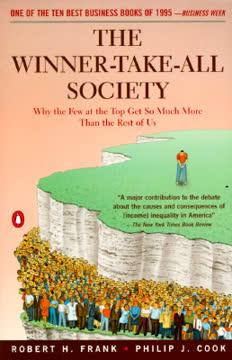
Book summary
Premium summary · Opens in the app · 30 min read
In 1980, the average chief executive of a large American corporation earned roughly forty times what the average worker made. By the late 1990s, that ratio had ballooned to more than four hundred times. During the same period, the gap between the highest-paid entertainers, athletes, lawyers, and financiers and their merely competent counterparts grew just as dramatically. Something fundamental had changed in how the economy rewards talent and effort.
**Author:** Robert H. Frank
**Estimated Reading Time:** 45 minutes
**What You'll Learn:**
Why a small number of people capture extraordinary rewards while most equally talented individuals struggle. How technology, psychology, and market forces combine to create winner-take-all dynamics across nearly every profession. What these forces mean for your career, your community, and the economy. And what can be done to create a more balanced and prosperous society.
**Who This Book Is For:**
Anyone who has wondered why the gap between the very successful and everyone else keeps growing. Professionals navigating increasingly competitive career landscapes. Parents thinking about education and opportunity. Citizens concerned about inequality and social cohesion. And anyone who wants to understand the hidden economic forces shaping modern life.
In 1980, the average chief executive of a large American corporation earned roughly forty times what the average worker made. By the late 1990s, that ratio had ballooned to more than four hundred times. During the same period, the gap between the highest-paid entertainers, athletes, lawyers, and financiers and their merely competent counterparts grew just as dramatically. Something fundamental had changed in how the economy rewards talent and effort. Robert H. Frank, an economist at Cornell University, spent years studying this transformation. What he discovered challenged conventional assumptions about how markets work. The standard economic story holds that people are paid according to the value they create. A worker who produces twice as much as another should earn roughly twice as much. But Frank found that in a growing number of markets, this relationship had broken down completely. Small differences in performance were translating into enormous differences in pay. The reason, Frank argues, lies in the nature of what he calls winner-take-all markets. These are markets where the value of what gets produced depends heavily on the efforts of only a small number of top performers. When the best singer in the world can record a song once and have it heard by billions, the second-best singer becomes almost irrelevant. When a company can hire the best lawyer in the country to handle a billion-dollar case, the difference between winning and losing dwarfs any reasonable fee. When a software program can be replicated at essentially zero cost, the developer who creates the most popular version captures nearly everything. This dynamic has always existed in entertainment and sports. Frank's crucial insight is that it has spread far beyond those traditional celebrity markets. The same forces now operate in law, finance, medicine, academia, publishing, consulting, and dozens of other professional fields. The result is an economy where a small number of winners capture extraordinary rewards while vast numbers of equally talented and hardworking people struggle to get by. The problem is not…
Continue reading in the MinuteRead app
Get the complete 30-minute summary of The Winner-Take-All Society
Get the complete summary in the appWinner-take-all markets concentrate rewards on a small number of top performers, even when the performance gap between t
Technology extends the reach of top performers, increasing the concentration of rewards across nearly every professional
Winner-take-all markets attract too many contestants because people overestimate their chances of success, leading to ov
Positional arms races occur when people spend ever-increasing amounts to maintain relative position, producing collectiv
Winner-take-all markets are a major driver of growing income inequality, which undermines social cohesion and economic m
Educational prestige has become a crucial gateway to top opportunities, transmitting privilege from one generation to th
"The Winner-Take-All Society" is a strong fit if you want practical ideas around economics, sociology, business, especially themes like winner-take-all markets concentrate rewards on a small number of top performers, even when the performance gap between t; technology extends the reach of top performers, increasing the concentration of rewards across nearly every professional. The MinuteRead summary distills these concepts into a focused read, whether you're deciding whether to buy the book or applying its lessons at work.
Robert H. Frank is a distinguished economist and professor at Cornell University's S.C. Johnson Graduate School of Management. He holds the position of Henrietta Johnson Louis Professor of Management and also teaches economics. Frank is known for his contributions to The New York Times, where he writes the "Economic View" column appearing every fifth Sunday. His work focuses on economic issues and their impact on society. As an author and academic, Frank has made significant contributions to the…
View all summaries by Robert H. FrankContinue Reading
Access the complete 30-minute summary and thousands more nonfiction books in the MinuteRead app.

Continue reading the complete summary in the MinuteRead app.