MinuteRead
30 min
Book summary
Premium summary · Opens in the app · 30 min read
The modern world is an economic world. We wake to alarm clocks manufactured across the ocean, drink coffee grown on distant continents, commute to jobs that did not exist a generation ago, and spend our days producing goods or services for people we will never meet. Our lives depend on a vast, intricate web of production and exchange that spans the globe. Yet most of us take this system for granted, as if it were a natural phenomenon like the weather.
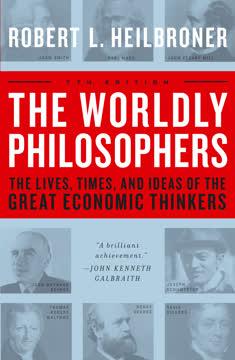
### By Robert L. Heilbroner
**Estimated Reading Time:** 2 hours, 45 minutes
**What You'll Learn**
The great economic thinkers were not merely technicians of supply and demand. They were worldly philosophers who sought to understand the deepest questions of human existence: How should we organize society? What drives people to work and create? Why do some nations prosper while others languish in poverty? This book takes you inside the minds of Adam Smith, Karl Marx, John Maynard Keynes, and other towering figures whose ideas shaped the modern world. You will learn how their theories emerged from the chaos of their times, how they battled one another across centuries, and how their insights remain startlingly relevant to the economic challenges we face today.
**Who This Book Is For**
This book is for anyone who senses that economics is too important to be left to economists. It is for the curious reader who wants to understand why capitalism works the way it does, where it came from, and where it might be headed. It is for the student who finds textbooks sterile and the professional who suspects that the real story of economics lies not in equations but in the clash of ideas, the drama of history, and the eternal struggle to build a just and prosperous society.
The modern world is an economic world. We wake to alarm clocks manufactured across the ocean, drink coffee grown on distant continents, commute to jobs that did not exist a generation ago, and spend our days producing goods or services for people we will never meet. Our lives depend on a vast, intricate web of production and exchange that spans the globe. Yet most of us take this system for granted, as if it were a natural phenomenon like the weather. It is not. The market system that organizes our material existence is a relatively recent invention. For most of human history, people did not live this way. They did not work for wages, shop in supermarkets, or save for retirement. They survived through tradition, following the patterns of their ancestors, or through command, obeying the orders of a ruler who directed the economic life of the community. The idea that each person could pursue their own self-interest and that this pursuit would somehow produce a functioning society was, for thousands of years, unthinkable. Then something extraordinary happened. Over the course of a few centuries, a new kind of society emerged. It was not planned by any king or parliament. It was not designed by philosophers. It grew out of countless individual decisions, a spontaneous order that no one intended but that transformed every aspect of human life. This transformation was the most important…
Continue reading in the MinuteRead app
Get the complete 30-minute summary of The Worldly Philosophers
Get the complete summary in the appThe market system is a revolutionary way of organizing society, not a natural state.
Adam Smith showed how self-interest, channeled through competition, can produce social good.
Malthus and Ricardo revealed the dark side of progress: population pressure and class conflict.
The utopian socialists kept alive the vision of an economy organized around cooperation rather than profit.
Marx argued that capitalism contains the seeds of its own destruction.
The Victorian economists made economics more scientific but less worldly.
"The Worldly Philosophers" is a strong fit if you want practical ideas around economics, philosophy, history—especially themes like the market system is a revolutionary way of organizing society, not a natural state; adam smith showed how self-interest, channeled through competition, can produce social good. The MinuteRead summary distills these concepts into a focused read, whether you're deciding whether to buy the book or applying its lessons at work.
Robert L. Heilbroner was an American economist and historian of economic thought, best known for his book "The Worldly Philosophers." Published in 1953, it became the second-best-selling economics text ever, with nearly four million copies sold. Heilbroner viewed himself as a social theorist and "worldly philosopher," integrating history, economics, and philosophy in his work. He was elected Vice President of the American Economic Association in 1972 and developed a system for classifying econom…
View all summaries by Robert L. HeilbronerContinue Reading
Access the complete 30-minute summary and thousands more nonfiction books in the MinuteRead app.

Continue reading the complete summary in the MinuteRead app.