MinuteRead
30 min
Book summary
Premium summary · Opens in the app · 30 min read
Economics has a problem. For centuries, the discipline has attempted to explain how individuals make choices, how markets allocate resources, and how societies organize production and exchange. Yet the tools economists developed to answer these questions were built on a foundation that could not support the weight of the questions themselves.
**Author:** John von Neumann
**Estimated Reading Time:** 45 minutes
**What You'll Learn:** How mathematical game theory provides a rigorous foundation for understanding economic behavior, strategic decision-making, and the formation of coalitions. You will learn why traditional economic models fall short, how utility can be measured through probability, what constitutes a stable solution in social exchange, and how the characteristic function quantifies coalition power.
**Who This Book Is For:** Readers who want to understand the mathematical foundations of strategic thinking. This condensed edition is for economists, social scientists, strategists, and intellectually curious readers who are willing to engage with rigorous ideas about how rational individuals interact when their fates are intertwined.
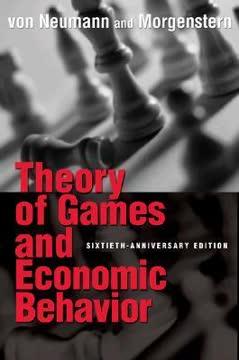
Economics has a problem. For centuries, the discipline has attempted to explain how individuals make choices, how markets allocate resources, and how societies organize production and exchange. Yet the tools economists developed to answer these questions were built on a foundation that could not support the weight of the questions themselves. The traditional economic model imagines an isolated individual, a Robinson Crusoe alone on an island, maximizing his satisfaction subject to the constraints of his environment. This model is elegant. It is mathematically tractable. It provides clear answers. But it fails at the precise moment when economics becomes interesting: when other people enter the picture. The moment a second person appears on the island, everything changes. Robinson Crusoe no longer faces a simple maximization problem. He faces another mind, another will, another set of interests that may align with his own or conflict with them. His outcomes now depend not only on his own choices but on the choices of someone else who is simultaneously trying to anticipate his choices. This is not a problem of optimization. It is a problem of strategy. John von Neumann recognized this fundamental gap in economic theory and set out to close it. His insight was that economics needed a mathematics of strategic interaction, a rigorous framework for analyzing situations where multiple individuals pursue their interests while accounting for the fact that others are doing the same. He found this framework in an unexpected place: the analysis of games. Games of strategy, from chess to poker, share essential features with economic situations. Players make choices. Outcomes depend on the combination of choices made by all players. Players have preferences over outcomes. Players must reason about what others will do. By developing a mathematical theory of games, von Neumann believed he could provide economics with the foundation it had been missing. This was not a modest ambition. Von Neumann and his collaborator Oskar Morgenstern set out to rebuild economics from the ground up, placing strategic interaction at the center of the analysis rather than treating…
Continue reading in the MinuteRead app
Get the complete 30-minute summary of Theory of Games and Economic Behavior
Get the complete summary in the appEconomic behavior is strategic interaction. The problems of economics are identical with the mathematical notions of sui
Traditional economics fails because it treats individuals as isolated maximizers. In social settings, outcomes depend on
Utility can be measured through choices involving risk. Preferences over gambles reveal numerical utilities.
A solution to a game is a set of stable standards of behavior. It specifies how each player should behave in every situa
In zero-sum games, the minimax theorem defines rational play. Each player can guarantee themselves a certain value regar
Randomization is valuable in pure conflict. Mixed strategies prevent opponents from exploiting your patterns.
"Theory of Games and Economic Behavior" is a strong fit if you want practical ideas around economics, science, mathematics, especially themes like economic behavior is strategic interaction. the problems of economics are identical with the mathematical notions of sui; traditional economics fails because it treats individuals as isolated maximizers. in social settings, outcomes depend on. The MinuteRead summary distills these concepts into a focused read, whether you're deciding whether to buy the book or applying its lessons at work.
John von Neumann was a Hungarian-American mathematician who made significant contributions to numerous fields, including set theory, quantum mechanics, economics, and computer science. He is considered one of the greatest mathematicians of the 20th century. Von Neumann pioneered the application of operator theory to quantum mechanics and played a crucial role in the Manhattan Project. He was also instrumental in developing game theory and cellular automata concepts. His work extended to nuclear …
View all summaries by John von NeumannContinue Reading
Access the complete 30-minute summary and thousands more nonfiction books in the MinuteRead app.

Continue reading the complete summary in the MinuteRead app.