MinuteRead
30 min
Book summary
Premium summary · Opens in the app · 30 min read
Every society on Earth has known poverty. For most of human history, poverty was the default condition of virtually everyone. What requires explanation is not poverty but wealth, not stagnation but progress, not inequality but the remarkable fact that some societies escaped the grinding deprivation that defined human existence for millennia.
**Author:** Thomas Sowell **Estimated Reading Time:** 45 minutes
**What You'll Learn:**
Why some nations prosper while others remain poor, how geography and culture shape economic destiny, why income statistics often mislead, and what actually drives human progress.
**Who This Book Is For:**
Readers who want to understand the deeper forces behind economic inequality, those tired of simplistic explanations for poverty and wealth, and anyone seeking a rigorous, evidence-based perspective on one of the most debated topics of our time.
Every society on Earth has known poverty. For most of human history, poverty was the default condition of virtually everyone. What requires explanation is not poverty but wealth, not stagnation but progress, not inequality but the remarkable fact that some societies escaped the grinding deprivation that defined human existence for millennia. Thomas Sowell spent decades asking a question that few economists and fewer politicians want to confront directly: Why do some groups and nations prosper while others, often living in the same country or even the same city, remain poor? The answer, he discovered, is neither simple nor comfortable. It involves geography, culture, politics, history, and human capital, all interacting in ways that defy the neat narratives favored by ideologues on both the left and the right. The problem with most discussions of wealth and poverty is that they begin with conclusions and then search for evidence. Some argue that poverty is entirely the result of exploitation and injustice. Others claim that wealth is simply the product of individual virtue and hard work. Sowell rejects both simplifications. His method is to examine the evidence first, across centuries and continents, and only then draw conclusions, even when those conclusions contradict fashionable beliefs. What makes this book distinctive is its scope. Sowell moves from ancient China to modern America, from the river systems of Western Europe to the mountains of the Andes, from the cultural values of East Asian immigrants to the welfare policies of Scandinavian nations. He examines not just economic data but history, geography, and demography. The result is a perspective that challenges conventional wisdom at every turn. One of the central insights of this book is that economic outcomes are rarely the result of any single factor. A nation's geography may provide advantages or obstacles, but geography alone does not determine destiny. Culture shapes attitudes toward work, education, and saving, but cultures change over time. Political decisions can accelerate or retard development, but they operate within constraints set by geography and history. Human capital, the knowledge and skills of a population, may be the most important factor of all, but it too is shaped by cultural and political forces. Sowell also challenges the way we measure economic reality. Income statistics,…
Continue reading in the MinuteRead app
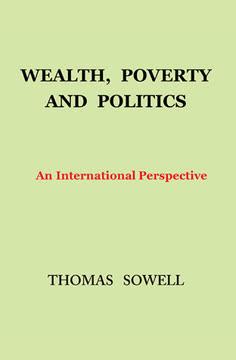
Get the complete 30-minute summary of Wealth, Poverty and Politics
Get the complete summary in the appGeography creates advantages and disadvantages, but human choices determine how these are used.
Culture shapes economic outcomes through values, attitudes, and trust.
Social mobility is far more prevalent than commonly perceived. Most people move up over time.
Political decisions have far-reaching economic consequences, often unintended.
Human capital is the key driver of economic progress, more important than natural resources.
Income statistics often misrepresent economic realities by comparing brackets rather than tracking individuals.
"Wealth, Poverty and Politics" is a strong fit if you want practical ideas around economics, politics, history, especially themes like geography creates advantages and disadvantages, but human choices determine how these are used; culture shapes economic outcomes through values, attitudes, and trust. The MinuteRead summary distills these concepts into a focused read, whether you're deciding whether to buy the book or applying its lessons at work.
Thomas Sowell is an American economist, social commentator, and author known for his laissez-faire economic perspective. Born in North Carolina and raised in Harlem, he overcame early challenges to earn degrees from Harvard, Columbia, and the University of Chicago. Sowell has taught at several universities and is currently a Senior Fellow at Stanford University's Hoover Institution. He has authored numerous books and articles, receiving recognition for his scholarship melding history, economics,…
View all summaries by Thomas SowellContinue Reading
Access the complete 30-minute summary and thousands more nonfiction books in the MinuteRead app.

Continue reading the complete summary in the MinuteRead app.