MinuteRead
30 min
Book summary
by Paul Nurse
Premium summary · Opens in the app · 5 min read
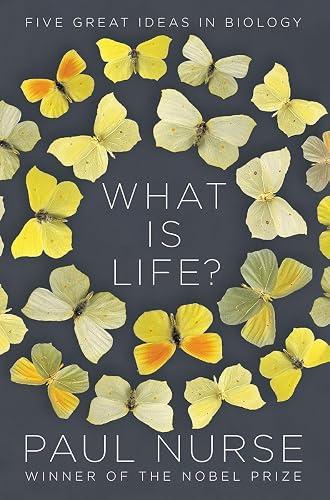
What Is Life? compresses a series of lectures given by the notorious physicist Erwin Schrödinger, and is a compelling research on how science, especially biology, chemistry and physics account for the ongoing process that the human body undertakes to simply exist and live.
What Is Life? compresses a series of lectures given by the notorious physicist Erwin Schrödinger, and is a compelling research on how science, especially biology, chemistry and physics account for the ongoing process that the human body undertakes to simply exist and live.
Everybody’s heard about atoms. But what are they, really? Essentially, they’re the tiniest part of any surrounding thing you can get your eyes on, and the way they function isn’t anything short of outstanding. Just think about it: everything you are, you touch or see, is made of atoms. They don’t have much relevance if you take them one by one, but together they form our world.
Although they don’t really follow an orderly way of functioning, nor any physical laws alone, once they get together in little clusters or molecules, they change their behaviour according to statistical law. In other words, they start following rules and change their orientation as a group. Their group defines what form they’ll take and what is their purpose.
To influence the overall behavior of organisms and follow a specific direction as an average, atoms must form huge groups. Still, tiny groups can have a significant influence. The most relevant example is a group of just a few million atoms forming a gene, which in turn is a part of a chromosome.
Genes play a role of utmost importance in your life, as they determine your development from the stage of a fertilized egg to maturity. Moreover, genes provide the blueprint and design of your entire being, along with practical implementation. This whole process happens at a microscopic level, but it affects your entire life – that’s how remarkable and important atoms are!
Charles Darwin promoted a large misconception about evolution. He stated that organisms develop in time by smooth, small changes that occur in a continuous and accidental way. Unfortunately, this theory proved to be wrong. In fact, evolution takes place in a much different way. Discontinuous changes, also called mutations, are responsible for the evolution of organisms. So how does it all happen? Consider the scientific premise that small systems can only possess a certain amount of energy. To grow their energy levels and thus evolve into a better version, the system must take a huge leap forward or a “quantum” leap. In this process, there’s no intermediary changes, nor a continuous and undergoing development, as Darwin concluded. Instead, these changes occur almost accidentally, and very rarely. What’s fascinating about this process is its close resemblance with the quantum theory, which states that atoms attach to each other to form molecules and they form specific configurations. To break their pattern and form new configurations, they must be brought to…
Continue reading in the MinuteRead app
Get the complete 5-minute summary of What Is Life?
Get the complete summary in the appAtoms define our world, and they function in a remarkable way.
Our evolution in time is based on quantum jumps that mutate the body in a positive way.
Consciousness is a remarkable trait of humans and it functions separately from sensations.
"What Is Life?" is a strong fit if you want practical ideas around education, environment, science, especially themes like atoms define our world, and they function in a remarkable way; our evolution in time is based on quantum jumps that mutate the body in a positive way. The MinuteRead summary distills these concepts into a focused read, whether you're deciding whether to buy the book or applying its lessons at work.
Motivated to help readers with what Is Life? compresses a series of lectures given by the notorious physicist Erwin Schrödinger, Paul Nurse wrote “What Is Life?” to package those ideas for a fast, focused read. In “What Is Life?”, Paul Nurse focuses on what Is Life? compresses a series of lectures given by the notorious physicist Erwin Schrödinger. Through “What Is Life?”, Paul Nurse distills the core ideas on education into lessons readers can absorb in a single short sitting. Readers turn to t…
View all summaries by Paul NurseContinue Reading
Access the complete 5-minute summary and thousands more nonfiction books in the MinuteRead app.

Continue reading the complete summary in the MinuteRead app.