MinuteRead
30 min
Book summary
Premium summary · Opens in the app · 30 min read
For decades, a strange consensus has dominated political debate in the developed world. The right claims that free markets have been under assault by an ever-expanding state. The left claims that unfettered capitalism has run amok, enriching the few at the expense of the many. Both sides agree on one thing: the problem is capitalism itself, either too much of it or too little.
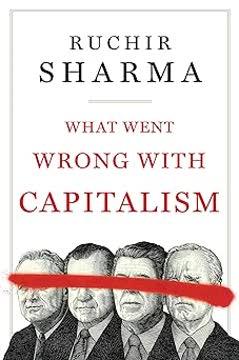
**Author:** Ruchir Sharma
**Estimated Reading Time:** 45 minutes
**What You'll Learn:**
- Why government spending has quadrupled across developed economies since 1930 - How easy money policies created a capitalism addicted to bailouts - Why zombie companies and oligopolies now dominate the economic landscape - What the decline of creative destruction means for innovation and growth - How successful capitalist models balance state involvement with market forces - What must change to restore capitalism's dynamism
**Who This Book Is For:**
This book is for anyone who senses that something fundamental has shifted in modern capitalism. It is for readers who wonder why economic growth feels sluggish despite constant technological innovation, why financial markets boom while wages stagnate, and why governments seem unable to step back from the economy. If you have questioned whether capitalism still works as advertised, this book offers a diagnosis that challenges both the right and the left.
For decades, a strange consensus has dominated political debate in the developed world. The right claims that free markets have been under assault by an ever-expanding state. The left claims that unfettered capitalism has run amok, enriching the few at the expense of the many. Both sides agree on one thing: the problem is capitalism itself, either too much of it or too little. Ruchir Sharma, a veteran global investor who has spent decades observing economies from the ground up, argues that both diagnoses are wrong. The real problem is not capitalism in its pure form. The real problem is that capitalism has been fundamentally distorted by decades of government intervention, easy money, and a growing addiction to bailouts. What we have today is not free-market capitalism but something closer to state-managed capitalism, where the government has become the dominant force in the economy while pretending to be a neutral referee. The numbers tell a story that most people have not fully absorbed. Since 1930, government spending in the leading capitalist economies has quadrupled as a share of GDP, rising from roughly 12 percent to nearly 48 percent on average. In the United States, often held up as the bastion of free enterprise, government spending has climbed from about 4 percent of GDP in 1930 to 36 percent today. In France, the figure now approaches 58 percent. This is not a story of free markets running wild. It is a story of the state steadily expanding its reach into every corner of economic life. But the growth of government is only part of the story. The more consequential shift has been in how governments intervene. In the past, state intervention was visible: nationalized industries, price controls, direct ownership. Today, intervention is often invisible: central banks manipulating interest rates, regulatory…
Continue reading in the MinuteRead app
Get the complete 30-minute summary of What Went Wrong with Capitalism
Get the complete summary in the appCapitalism has not failed because it was too free, but because it was not free enough. Government intervention has disto
Government spending has quadrupled as a share of GDP in developed economies since 1930. The era of small government is a
Cheap money has encouraged excessive risk-taking, inflated asset bubbles, and enabled unsustainable debt.
Zombie companies, which cannot cover their debt payments with profits, now make up more than 20 percent of U.S. publicly
Oligopolies have proliferated across many industries, reducing competition and innovation.
The pace of creative destruction has slowed dramatically, reducing economic dynamism and productivity growth.
"What Went Wrong with Capitalism" is a strong fit if you want practical ideas around economics, politics, history, especially themes like capitalism has not failed because it was too free, but because it was not free enough. government intervention has disto; government spending has quadrupled as a share of gdp in developed economies since 1930. the era of small government is a. The MinuteRead summary distills these concepts into a focused read, whether you're deciding whether to buy the book or applying its lessons at work.
Ruchir Sharma is a prominent global investor and author with extensive experience in emerging markets. He currently serves as Chairman of Rockefeller International and Founder/CIO of Breakout Capital. Previously, Sharma spent 25 years at Morgan Stanley Investment Management, rising to Chief Global Strategist and Head of Emerging Markets. Known for his frequent travels and meetings with political and business leaders, Sharma developed a system for identifying promising economies, which he detaile…
View all summaries by Ruchir SharmaContinue Reading
Access the complete 30-minute summary and thousands more nonfiction books in the MinuteRead app.

Continue reading the complete summary in the MinuteRead app.