MinuteRead
30 min
Book summary
Premium summary · Opens in the app · 30 min read
We live in a culture obsessed with objectives. From the moment we enter school, we are taught to set goals, measure progress, and work steadily toward predetermined outcomes. Teachers write learning objectives on whiteboards. Corporations establish quarterly targets and key performance indicators. Parents ask children what they want to be when they grow up, expecting a specific answer. The message is consistent and pervasive: decide where you want to go, then figure out how to get there.
**Author:** Kenneth O. Stanley
**Estimated Reading Time:** 42 minutes
**What You'll Learn:**
* Why setting ambitious objectives often leads to mediocrity rather than greatness * How the stepping stones to major discoveries are almost always invisible from the starting point * Why following curiosity and interestingness outperforms rigid goal-setting in complex domains * How to apply non-objective search principles to your career, creative work, and personal life * Why diversity of thought is not just nice to have but essential for genuine progress
**Who This Book Is For:**
This book is for anyone who has ever felt frustrated by the gap between ambitious goals and actual results. It is for innovators, creators, researchers, educators, and leaders who suspect that the conventional wisdom about goal-setting is incomplete. It is for people who want to understand why some of the greatest achievements in human history emerged from meandering paths rather than straight lines, and how to apply that insight to their own pursuits.
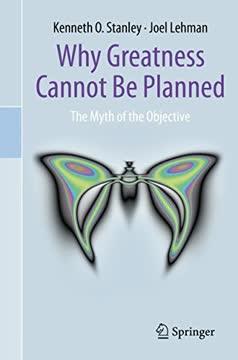
We live in a culture obsessed with objectives. From the moment we enter school, we are taught to set goals, measure progress, and work steadily toward predetermined outcomes. Teachers write learning objectives on whiteboards. Corporations establish quarterly targets and key performance indicators. Parents ask children what they want to be when they grow up, expecting a specific answer. The message is consistent and pervasive: decide where you want to go, then figure out how to get there. This approach seems so obviously correct that questioning it feels almost irresponsible. After all, how can you accomplish anything meaningful without first defining what you want to accomplish? How can you measure progress without a clear destination? How can you know if you are succeeding without a benchmark to compare against? Kenneth O. Stanley, a computer scientist and artificial intelligence researcher, discovered something that turned this conventional wisdom on its head. While working on algorithms designed to solve complex problems, he noticed a strange phenomenon. The algorithms that performed best on ambitious, open-ended challenges were not the ones carefully designed to reach specific targets. They were the ones that simply explored interesting possibilities without any fixed destination in mind. This observation emerged most dramatically from a project called Picbreeder, an online platform where users could breed images through a process similar to natural selection. Users would start with simple shapes and select the ones they found most interesting, generation after generation. Over time, remarkable images emerged: butterflies, alien faces, cars, and intricate patterns. But here is the crucial insight: none of these outcomes were planned. No user could have set out to create a butterfly from the starting point. The stepping stones that led to those images were unrecognizable as precursors to…
Continue reading in the MinuteRead app
Get the complete 30-minute summary of Why Greatness Cannot Be Planned
Get the complete summary in the appAmbitious objectives are often counterproductive. The more ambitious the goal, the less likely you are to achieve it by
The stepping stones to greatness are usually invisible from the starting point. They do not resemble the final destinati
Objective-driven search systematically eliminates valuable stepping stones because they do not appear to lead to the goa
Novelty search, which rewards finding something different rather than making progress toward a goal, often outperforms o
Serendipity is not pure luck. It requires openness to the unexpected and the ability to recognize significance when it a
Divergence is essential for innovation. Protecting diverse perspectives is not just nice to have; it is necessary for pr
"Why Greatness Cannot Be Planned" is a strong fit if you want practical ideas around philosophy, science, business, especially themes like ambitious objectives are often counterproductive. the more ambitious the goal, the less likely you are to achieve it by; the stepping stones to greatness are usually invisible from the starting point. they do not resemble the final destinati. The MinuteRead summary distills these concepts into a focused read, whether you're deciding whether to buy the book or applying its lessons at work.
Kenneth O. Stanley is a computer scientist and artificial intelligence researcher known for his work on neuroevolution and novelty search algorithms. He co-authored "Why Greatness Cannot Be Planned" based on insights from his AI research, particularly his experience with the Picbreeder project. Stanley has applied his findings on non-objective search to various fields beyond AI, including education, innovation, and personal development. His work challenges conventional wisdom about goal-setting …
View all summaries by Kenneth O. StanleyContinue Reading
Access the complete 30-minute summary and thousands more nonfiction books in the MinuteRead app.

Continue reading the complete summary in the MinuteRead app.