MinuteRead
30 min
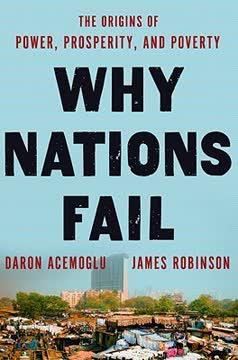
Why are some nations rich and others poor? This question has puzzled thinkers for centuries. Look at a map of the world. The United States has an average income more than twenty times higher than Mali or Guatemala. South Korea is one of the richest countries in Asia. North Korea, sharing the same peninsula, the same language, and the same history until 1945, is one of the poorest. Walk across the border from Nogales, Arizona to Nogales, Sonora. On one side, people live long lives, own homes, sen
**Author:** Daron Acemoğlu and James A. Robinson **Estimated Reading Time:** 45 minutes
**What You'll Learn** The true origins of global inequality and why some nations prosper while others remain trapped in poverty. You will discover why geography, culture, and natural resources do not determine a nation's fate. Instead, you will learn how political and economic institutions shape prosperity, why some systems create virtuous cycles of growth while others spiral into decline, and what history teaches about breaking the cycle of poverty.
**Who This Book Is For** Anyone who has looked at the vast differences between rich and poor countries and wondered why they exist. Students of economics, history, and political science. Policymakers seeking to understand development. And every curious reader who wants to understand the hidden forces that shape our world.
Why are some nations rich and others poor? This question has puzzled thinkers for centuries. Look at a map of the world. The United States has an average income more than twenty times higher than Mali or Guatemala. South Korea is one of the richest countries in Asia. North Korea, sharing the same peninsula, the same language, and the same history until 1945, is one of the poorest. Walk across the border from Nogales, Arizona to Nogales, Sonora. On one side, people live long lives, own homes, send their children to good schools, and expect their government to protect their rights. On the other side, just a few feet away, people struggle with poverty, corruption, and insecurity. Same geography. Same culture. Same climate. Radically different outcomes. For generations, people have offered comfortable answers to this puzzle. Some pointed to geography. Tropical countries are poor because heat breeds disease and makes people lazy. Some pointed to culture. Certain religions or value systems supposedly discourage hard work and innovation. Some pointed to ignorance. Poor countries simply do not know how to run their economies properly, and with enough expert advice and foreign aid, they will catch up. These explanations fail the moment you examine them closely. Singapore sits almost on the equator and is one of the wealthiest places on earth. China, supposedly held back by Confucian values, became an economic powerhouse once it changed its policies. Foreign aid has poured into Africa for decades with little to show for it. The geography hypothesis, the culture hypothesis, and the ignorance hypothesis all collapse under scrutiny. The real answer lies in institutions. Not the buildings or organizations we usually think of, but the rules of the game. The laws, regulations, customs, and enforcement mechanisms that shape how people interact economically and politically. Some societies develop inclusive institutions that allow broad participation, protect property rights, and create a level playing field. Others develop…
Continue reading in the MinuteRead app
Get the complete 30-minute summary of Why Nations Fail
Get the complete summary in the appInstitutions, not geography or culture, determine whether nations prosper or fail.
Inclusive institutions create broad prosperity. Extractive institutions concentrate wealth and power.
The two Koreas prove that shared geography and culture mean nothing without shared institutions.
Critical junctures are moments of upheaval when institutional change becomes possible.
Small differences can lead to large divergence when amplified by critical junctures.
Inclusive institutions create virtuous circles that make them self-reinforcing.
"Why Nations Fail" is a strong fit if you want practical ideas around economics, politics, history—especially themes like institutions, not geography or culture, determine whether nations prosper or fail; inclusive institutions create broad prosperity. extractive institutions concentrate wealth and power. The MinuteRead summary distills these concepts into a focused read, whether you're deciding whether to buy the book or applying its lessons at work.
Daron Acemoglu is a prominent economist and professor at MIT, known for his work on political economy and economic growth. He earned the prestigious John Bates Clark medal in 2005, recognizing him as the top economist under 40. Acemoglu's research focuses on the role of institutions in economic development, which forms the basis for "Why Nations Fail." His academic contributions have significantly influenced modern economic thought, particularly in understanding the interplay between political s…
View all summaries by Daron AcemoğluContinue Reading
Access the complete 30-minute summary and thousands more nonfiction books in the MinuteRead app.

Continue reading the complete summary in the MinuteRead app.