MinuteRead
30 min
Book summary
Premium summary · Opens in the app · 30 min read
There is a moment in the life of every problem when it seems impossible. The constraints are too tight. The users are too unpredictable. The technology is not ready. The budget is too small. And yet, somewhere, a designer looks at the same situation and sees something else entirely. She sees a puzzle worth solving. He sees a chance to ask a question no one else has asked. They see the glimmer of a possibility.
**Author:** Warren Berger
**Estimated Reading Time:** 45 minutes
**What You'll Learn:** How design thinking evolved from a niche professional discipline into a universal method for solving problems, why the best designers ask questions that sound naive, and how you can apply the glimmer-driven, prototype-friendly mindset of great designers to your own work and life.
**Who This Book Is For:** Anyone who suspects that the old ways of solving problems no longer work. Whether you lead a business, teach students, build products, or simply want to think more creatively about the challenges in front of you, this book offers a window into how designers see the world and how you can adopt their most powerful habits.
There is a moment in the life of every problem when it seems impossible. The constraints are too tight. The users are too unpredictable. The technology is not ready. The budget is too small. And yet, somewhere, a designer looks at the same situation and sees something else entirely. She sees a puzzle worth solving. He sees a chance to ask a question no one else has asked. They see the glimmer of a possibility. This book is about that moment and the people who live for it. For most of the twentieth century, design was understood as a finishing touch. You built a product, then you hired a designer to make it look nice. You wrote a brochure, then you asked a designer to make it pretty. Design was decoration, and designers were the people who chose colors and fonts. That understanding was never quite accurate, but it was comfortable. It allowed businesses to treat design as an afterthought and designers as a service department. Then something changed. The problems facing businesses and society became too complex for the old linear approaches. A company could no longer simply engineer a better product and expect to win. A hospital could no longer simply add more beds and expect patients to heal. A school could no longer simply assign more homework and expect students to learn. The problems were messier than that. They involved human behavior, hidden needs, conflicting incentives, and systems that interacted in unpredictable ways. Designers, it turned out, had been thinking about these kinds of messy problems all along. The central insight of this book is that design is not really about making things look good. It is about looking at the world with an eye toward changing it. It is a way of thinking, a method for approaching problems, and a set of habits that can be learned by anyone. The designers profiled in these pages are not geniuses operating in isolation. They are people who have trained themselves to ask better…
Continue reading in the MinuteRead app
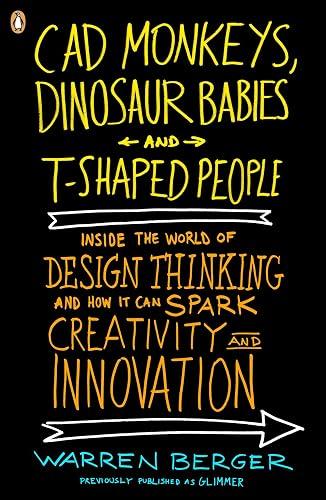
Get the complete 30-minute summary of CAD Monkeys, Dinosaur Babies, and T-Shaped People
Get the complete summary in the appDesign is problem-solving, not decoration.
Ask stupid questions. They challenge the assumptions that keep us stuck.
Empathize with your users. Observe them. Immerse yourself in their world.
Embrace constraints. They focus the mind and spark creativity.
Build rough prototypes early and often. Test them against reality.
Think about the entire experience, not just the product.
"CAD Monkeys, Dinosaur Babies, and T-Shaped People" is a strong fit if you want practical ideas around design, business, psychology, especially themes like design is problem-solving, not decoration; ask stupid questions. they challenge the assumptions that keep us stuck. The MinuteRead summary distills these concepts into a focused read, whether you're deciding whether to buy the book or applying its lessons at work.
Motivated to help readers with "Design is really a way of looking at the world with an eye toward changing it." Design is problem-solving, Warren Berger wrote “CAD Monkeys, Dinosaur Babies, and T-Shaped People” to package those ideas for a fast, focused read. In “CAD Monkeys, Dinosaur Babies, and T-Shaped People”, Warren Berger focuses on "Design is really a way of looking at the world with an eye toward changing it." Design is problem-solving. Through “CAD Monkeys, Dinosaur Babies, and T-Shaped…
View all summaries by Warren BergerContinue Reading
Access the complete 30-minute summary and thousands more nonfiction books in the MinuteRead app.

Continue reading the complete summary in the MinuteRead app.