MinuteRead
30 min
Book summary
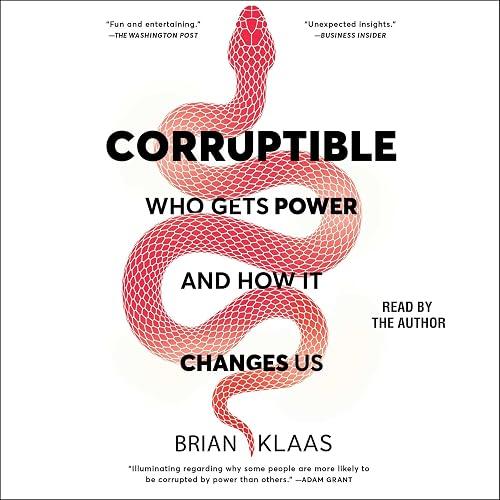
by Brian Klaas
Premium summary · Opens in the app · 30 min read
The question has haunted humanity for millennia. Why do the wrong people so often end up in charge? From the petty tyrant in the corner office to the dictator in the palace, the pattern repeats across cultures, centuries, and contexts. We keep choosing leaders who disappoint us, abuse us, or actively harm us. And we keep telling ourselves the same comforting story: power corrupts. Good people get into positions of authority and somehow turn bad.
**Author:** Brian Klaas
**Estimated Reading Time:** 45 minutes
**What You'll Learn:** Why power attracts the wrong people, how our evolutionary instincts betray us when choosing leaders, what actually causes corruption, and practical ways to build systems that keep power in check.
**Who This Book Is For:** Anyone who has ever wondered why bad leaders so often rise to the top, struggled with a toxic boss, or wanted to understand how to create organizations and societies where power is wielded responsibly.
The question has haunted humanity for millennia. Why do the wrong people so often end up in charge? From the petty tyrant in the corner office to the dictator in the palace, the pattern repeats across cultures, centuries, and contexts. We keep choosing leaders who disappoint us, abuse us, or actively harm us. And we keep telling ourselves the same comforting story: power corrupts. Good people get into positions of authority and somehow turn bad. Brian Klaas spent years studying this problem as a political scientist, traveling the world examining authoritarian regimes, failed democracies, and broken institutions. What he found challenged the most basic assumptions about power and corruption. The problem is not simply that power corrupts. The problem is that power attracts the corruptible. This distinction matters enormously. If power corrupts, then the solution is to find good people and protect them from the corrupting influence of authority. But if power attracts the corruptible, then the solution is fundamentally different. We need to change who gets into power in the first place, and build systems that filter out those who seek power for the wrong reasons. The evidence for this alternative view comes from unexpected places. Two shipwrecks on opposite sides of the world, centuries apart, provide a natural experiment in what happens when people are given power without constraints. In one case, a Dutch merchant ship called the Batavia ran aground off the coast of Western Australia in 1629. Jeronimus Cornelisz, a failed apothecary with a history of heretical beliefs, took control of the survivors. What followed was a nightmare. Cornelisz orchestrated the murder of more than 100 men, women, and children, creating a reign of terror on a tiny island. He was not corrupted by power. He was a corruptible person who seized power the moment it became available. Centuries later, in 1965, six Tongan teenagers stole a boat and got caught in a storm. They drifted for eight days before washing up on the uninhabited island of 'Ata. Instead of descending into chaos, they created a functioning society. They established rules, divided labor, resolved conflicts peacefully, and kept a fire burning continuously for 15 months until they were rescued. No one seized control. No one abused…
Continue reading in the MinuteRead app
Get the complete 30-minute summary of Corruptible
Get the complete summary in the appPower attracts the corruptible. The people who most want power are often the people who should least have it.
Our Stone Age brains choose poor leaders. We favor tall, confident, familiar individuals, even when these traits do not
Bad systems, not just bad people, cause power abuses. Changing systems is harder but more effective than firing individu
Power does corrupt, but less than we think. Dirty hands, learning, opportunity, and scrutiny create the illusion of corr
Power changes our bodies and behavior. Low status harms health, and high status with low control is also harmful.
Actively recruit incorruptible people. Broaden applicant pools and screen for traits that predict responsible leadership
"Corruptible" is a strong fit if you want practical ideas around politics, psychology, sociology, especially themes like power attracts the corruptible. the people who most want power are often the people who should least have it; our stone age brains choose poor leaders. we favor tall, confident, familiar individuals, even when these traits do not. The MinuteRead summary distills these concepts into a focused read, whether you're deciding whether to buy the book or applying its lessons at work.
Motivated to help readers with "Somewhat unexpectedly, Brian Klaas wrote “Corruptible” to package those ideas for a fast, focused read. In “Corruptible”, Brian Klaas focuses on "Somewhat unexpectedly. Through “Corruptible”, Brian Klaas distills the core ideas on politics into lessons readers can absorb in a single short sitting. Readers turn to this work when they want Brian Klaas's perspective on the subject without working through the entire original volume. Brian Paul Klaas (born June 29, 198…
Continue Reading
Access the complete 30-minute summary and thousands more nonfiction books in the MinuteRead app.

Continue reading the complete summary in the MinuteRead app.