MinuteRead
30 min
Book summary
Premium summary · Opens in the app · 30 min read
Something strange has happened to the conversation about crime and justice in America. Over the past decade, a set of ideas that once occupied the fringes of policy debate has moved to the center. The language of mass incarceration, systemic racism, and police violence now dominates news coverage, political campaigns, and dinner table conversations. Reform proposals that would have seemed radical twenty years ago have become mainstream, even moderate.
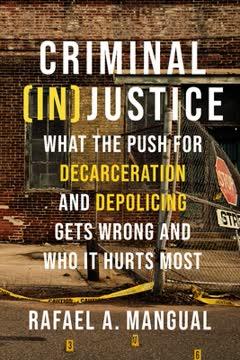
**Author:** Rafael A. Mangual **Estimated Reading Time:** 45 minutes
**What You'll Learn**
The real story behind America's criminal justice system, told through data rather than headlines. You will discover why violent crime concentrates in specific places and among specific populations, who actually populates American prisons, how police use force far less often than most people believe, and why well-intentioned reforms can produce devastating consequences for the communities they aim to protect.
**Who This Book Is For**
This book is for anyone who senses that the public conversation about crime and justice has drifted away from reality. It is for readers who want to understand what the data actually shows about policing, incarceration, and public safety. It is for people willing to question comfortable narratives and confront uncomfortable truths. If you have ever wondered whether the criminal justice reform movement has considered the full costs of its proposals, this book will give you the evidence you need to think clearly about one of the most consequential issues of our time.
Something strange has happened to the conversation about crime and justice in America. Over the past decade, a set of ideas that once occupied the fringes of policy debate has moved to the center. The language of mass incarceration, systemic racism, and police violence now dominates news coverage, political campaigns, and dinner table conversations. Reform proposals that would have seemed radical twenty years ago have become mainstream, even moderate. The problem is that much of what people believe about the criminal justice system is wrong. Not slightly wrong. Not debatable. Fundamentally disconnected from the data. Consider a few facts that rarely make headlines. Over half of America's counties record zero murders in a typical year. Violent crime concentrates so intensely that roughly 2 percent of counties account for half of all murders nationwide. The average state prisoner has been arrested ten to twelve times before and has five to six prior convictions. Police officers discharge their firearms in approximately 0.03 percent of arrests. Less than 15 percent of state prisoners are incarcerated primarily for drug offenses. These numbers tell a story that bears little resemblance to the one most Americans hear. Rafael Mangual wrote this book because he watched the public conversation about criminal justice become untethered from reality. As a researcher at the Manhattan Institute and the son of an NYPD detective, he had access to data that contradicted the dominant narrative. He saw reform proposals gaining momentum without serious consideration of their likely consequences. He watched as complex questions about public safety, justice, and human behavior were reduced to slogans. The book makes a statistical argument. It does not ask readers to trust Mangual's opinions or political preferences. It…
Continue reading in the MinuteRead app
Get the complete 30-minute summary of Criminal (In)Justice
Get the complete summary in the appViolent crime concentrates in specific places. Two percent of counties account for half of all murders. Most Americans l
The average state prisoner is a violent or repeat offender, not a low-level drug offender. Over 60 percent of state pris
The average state prisoner has ten to twelve prior arrests and five to six prior convictions. The system incarcerates re
Police shootings occur in approximately 0.03 percent of arrests. Police use of force is far rarer than media coverage su
Black Americans are more than ten times more likely than white Americans to be homicide victims. Victimization dispariti
Cash bail is unjust, but the solution is risk-based decision-making, not releasing everyone regardless of danger.
"Criminal (In)Justice" is a strong fit if you want practical ideas around politics, sociology, law, especially themes like violent crime concentrates in specific places. two percent of counties account for half of all murders. most americans l; the average state prisoner is a violent or repeat offender, not a low-level drug offender. over 60 percent of state pris. The MinuteRead summary distills these concepts into a focused read, whether you're deciding whether to buy the book or applying its lessons at work.
Rafael A. Mangual is a senior fellow and head of research for the Policing and Public Safety Initiative at the Manhattan Institute. He has been researching criminal justice policy and outcomes since 2015. Mangual's work has been published in various outlets, including City Journal, where he contributes alongside colleagues like Heather MacDonald and Christopher Rufo. As the son of an NYPD detective, Mangual brings a unique perspective to his analysis of law enforcement and criminal justice issue…
View all summaries by Rafael A. MangualContinue Reading
Access the complete 30-minute summary and thousands more nonfiction books in the MinuteRead app.

Continue reading the complete summary in the MinuteRead app.