MinuteRead
30 min
Book summary
Premium summary · Opens in the app · 30 min read
Look around you. The chair you are sitting on, the screen you are reading from, the room you are in, the building that contains it, the street outside, the laws that govern the street, the economy that pays for the building, the language you use to describe all of it. Every single one of these things is artificial. Every single one was designed by human beings.
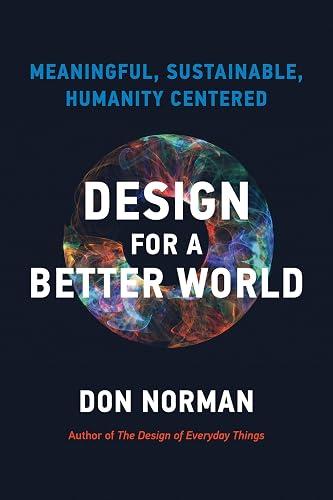
**Design for a Better World**
*Meaningful, Sustainable, Humanity Centered*
By Donald A. Norman
**Estimated Reading Time:** 45 minutes
**What You'll Learn**
Why the artificial world around you was designed, often badly. How the measurements we use to judge progress are misleading us. What a circular economy actually requires. Why human-centered design is no longer enough. How technology can become a servant rather than a master. And how small, deliberate changes can reshape the systems that shape your life.
**Who This Book Is For**
Anyone who has ever looked at a product, a policy, a building, or a bureaucracy and thought: *Someone designed this. Surely they could have done better.* This book is for designers who want to expand their practice, for citizens who want to understand why the world works the way it does, and for anyone who suspects that the systems we live inside are not inevitable. They were made. Which means they can be remade.
Look around you. The chair you are sitting on, the screen you are reading from, the room you are in, the building that contains it, the street outside, the laws that govern the street, the economy that pays for the building, the language you use to describe all of it. Every single one of these things is artificial. Every single one was designed by human beings. This is a strange thought to sit with, because most of us move through life treating the artificial world as if it were the natural one. We complain about traffic as though it were weather. We accept bureaucratic inefficiency as though it were gravity. We assume that the way things are is the way things must be. But Donald Norman wants us to notice something important: the world we inhabit is almost entirely made by human decisions. And if it was made by decisions, it can be unmade and remade by different decisions. That is the central promise of this book, and it is more radical than it sounds. Norman has spent his career thinking about design. He is best known for *The Design of Everyday Things*, a book that taught millions of people to notice door handles that confuse, stoves that mislead, and software that frustrates. But in *Design for a Better World*, he steps back from individual objects to look at the larger systems that produce them. He asks a harder question: not just *is this object well designed*, but *is this system well designed for the flourishing of people and the planet*? The answer, too often, is no. Our economic systems measure the wrong things. Our production systems create waste at a scale that is difficult to comprehend. Our technological systems are optimized for…
Continue reading in the MinuteRead app
Get the complete 30-minute summary of Design for a Better World
Get the complete summary in the appAlmost everything around you is artificial and designed, which means it can be redesigned.
Path dependency makes change difficult, but it does not make it impossible. The path can be changed with deliberate effo
What we measure determines what we value. GDP measures production, not well-being. Choose better metrics.
The linear "take-make-waste" economy is unsustainable. Shift to a circular economy that eliminates waste by design.
Human-centered design is too narrow. Expand to humanity-centered design that considers all people, future generations, a
Technology should serve people, not the other way around. Design for human control, transparency, and decision-making.
"Design for a Better World" is a strong fit if you want practical ideas around design, sustainability, environment, especially themes like almost everything around you is artificial and designed, which means it can be redesigned; path dependency makes change difficult, but it does not make it impossible. the path can be changed with deliberate effo. The MinuteRead summary distills these concepts into a focused read, whether you're deciding whether to buy the book or applying its lessons at work.
Motivated to help readers with almost everything I see is artificial, Donald A. Norman wrote “Design for a Better World” to package those ideas for a fast, focused read. In “Design for a Better World”, Donald A. Norman focuses on almost everything I see is artificial. Through “Design for a Better World”, Donald A. Norman distills the core ideas on design into lessons readers can absorb in a single short sitting. Readers turn to this work when they want Donald A. Norman's perspective on the subje…
View all summaries by Donald A. NormanContinue Reading
Access the complete 30-minute summary and thousands more nonfiction books in the MinuteRead app.

Continue reading the complete summary in the MinuteRead app.