MinuteRead
30 min
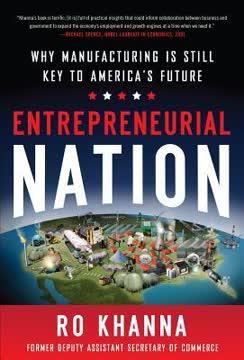
For decades, Americans have been told a simple story about manufacturing. The story goes like this: America used to make things. Then globalization happened. Factories closed. Jobs moved overseas. China rose. America declined. The end.
**Author:** Ro Khanna
**Estimated Reading Time:** 42 minutes
**What You'll Learn:**
Why American manufacturing is not dying but transforming. How innovation, regional clusters, and a new generation of entrepreneurs are reshaping the industrial landscape. What policies, practices, and mindsets can strengthen America's competitive position in the global economy.
**Who This Book Is For:**
Entrepreneurs considering manufacturing ventures, policymakers seeking practical frameworks for economic development, students exploring careers in industry, and anyone who wants to understand how America can compete and win in the twenty-first century economy.
For decades, Americans have been told a simple story about manufacturing. The story goes like this: America used to make things. Then globalization happened. Factories closed. Jobs moved overseas. China rose. America declined. The end. This story is not just incomplete. It is dangerously misleading. The truth is more complex and far more hopeful. American manufacturing output has more than doubled over the past thirty years. The United States remains one of the world's largest manufacturing economies, producing more value per worker than almost any nation on earth. The real story is not about decline but about transformation. The question is not whether America can make things. The question is whether America can make the right things, in the right places, with the right people, and for the right reasons. Ro Khanna wrote "Entrepreneurial Nation" to answer that question. As a member of Congress representing Silicon Valley, he occupies an unusual position. He sees both the extraordinary innovation of the technology sector and the struggles of communities that have been left behind by economic change. He has visited factories in Wichita, Cleveland, and Detroit. He has met with entrepreneurs in San Francisco and Boston. He has studied the policies that helped some regions thrive while others faltered. What he discovered challenges conventional wisdom on both the left and the right. The left often assumes that manufacturing requires heavy government intervention, protectionist policies, and central planning. The right often assumes that government should simply get out of the way and let markets work their magic. Khanna argues that neither approach is sufficient. The real answer lies in understanding how successful manufacturing ecosystems actually develop. They develop from the bottom up. They grow through entrepreneurship. They depend on collaboration between workers, engineers, universities, and local institutions. They thrive when government plays a supporting role rather than a directing role. They succeed when they focus on innovation, customization, and quality rather than competing solely on cost. This book is not a nostalgic plea to return to some imagined golden age of American industry. It is not a collection of policy prescriptions detached from reality. It is a ground-level examination of what is actually working in American manufacturing…
Continue reading in the MinuteRead app
Get the complete 30-minute summary of Entrepreneurial Nation
Get the complete summary in the appAmerican manufacturing is transforming, not dying. Output has more than doubled over thirty years.
American workers are over six times more productive than workers in China or India.
Compete on value, not cost. Quality, customization, and innovation create sustainable advantage.
Invest in your workers. A skilled, motivated workforce is the foundation of high-road manufacturing.
Clusters develop organically. Government can support them but cannot create them from scratch.
Embrace failure as a learning experience. Risk-taking enables breakthrough innovation.
"Entrepreneurial Nation" is a strong fit if you want practical ideas around politics, business, especially themes like american manufacturing is transforming, not dying. output has more than doubled over thirty years; american workers are over six times more productive than workers in china or india. The MinuteRead summary distills these concepts into a focused read, whether you're deciding whether to buy the book or applying its lessons at work.
Ro Khanna is the author of "Entrepreneurial Nation," a book focusing on US manufacturing and entrepreneurship. As a member of Congress, Khanna brings a unique perspective to the topic, combining political insight with economic analysis. His work emphasizes the importance of small manufacturers and job creation in America. Khanna's approach is generally optimistic, highlighting success stories and potential for growth in the manufacturing sector. He also addresses policy considerations, suggestin…
View all summaries by Ro KhannaContinue Reading
Access the complete 30-minute summary and thousands more nonfiction books in the MinuteRead app.

Continue reading the complete summary in the MinuteRead app.