MinuteRead
30 min
Book summary
Premium summary · Opens in the app · 30 min read
Every day, we turn to experts to help us navigate an uncertain world. We listen to political pundits on television, read economic forecasts in newspapers, and seek guidance from foreign policy specialists. We assume that people with decades of experience, advanced degrees, and access to privileged information must have some special insight into what will happen next.
**Author:** Philip E. Tetlock
**Estimated Reading Time:** 42 minutes
**What You'll Learn:**
- Why most experts are no better at predicting the future than random chance - The crucial difference between "foxes" and "hedgehogs" in thinking style - How cognitive biases protect experts from admitting error - Why the media rewards confident but inaccurate forecasters - What actually improves judgment and forecasting ability
**Who This Book Is For:**
Anyone who consumes political commentary, makes decisions under uncertainty, or has ever wondered why the experts so often get it wrong. This book is for leaders, analysts, investors, students of human behavior, and citizens who want to think more clearly about the future.
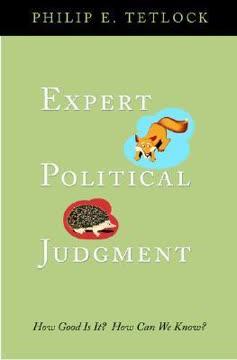
Every day, we turn to experts to help us navigate an uncertain world. We listen to political pundits on television, read economic forecasts in newspapers, and seek guidance from foreign policy specialists. We assume that people with decades of experience, advanced degrees, and access to privileged information must have some special insight into what will happen next. Philip Tetlock spent twenty years testing this assumption. What he found is deeply unsettling. Beginning in the mid-1980s, Tetlock and his research team collected more than 28,000 predictions from 284 experts in politics, economics, and international affairs. These were not amateurs or casual commentators. They were professors, government officials, journalists, and think tank analysts, many with distinguished careers and impressive credentials. The researchers asked them to make specific predictions about real-world events: Would the Soviet Union collapse? Would there be a recession? Would a particular election produce a peaceful transfer of power? Then Tetlock waited. And scored. And waited some more. The results were sobering. When asked to predict outcomes within their areas of expertise, these professionals performed only slightly better than random guessing. They were routinely outperformed by simple extrapolation algorithms that assumed current trends would continue. And they were decisively beaten by even basic statistical models. Perhaps most troubling was the finding that expertise itself seemed to offer little protection against error. A distinguished professor with thirty years of experience was no more accurate than a well-informed graduate student. Access to classified information did not improve forecasting. A PhD in political science did not help. Even fame and reputation were useless as predictors of accuracy. If anything, the most famous experts tended to be the least reliable forecasters, in part because their confidence made them attractive to media outlets seeking definitive answers. But Tetlock's research did not end with this discouraging conclusion. Buried within the data was a more hopeful finding: some experts did perform better than others. The difference was not in what they believed but in how they thought. Drawing on Isaiah Berlin's famous distinction between the hedgehog…
Continue reading in the MinuteRead app
Get the complete 30-minute summary of Expert Political Judgment
Get the complete summary in the appExperts are no better at predicting the future than random chance, and they are systematically overconfident.
Foxes outperform hedgehogs. Intellectual humility and openness to complexity beat single-minded certainty.
Credentials do not matter. PhDs, experience, and access to secrets do not improve forecasting.
When predictions fail, experts rationalize rather than learn. Belief system defenses protect worldviews at the cost of a
Hindsight bias makes us believe we predicted events that we did not. Keep a prediction journal to protect against this i
The media rewards confidence, not accuracy. The most visible experts are often the least reliable.
"Expert Political Judgment" is a strong fit if you want practical ideas around politics, psychology, science, especially themes like experts are no better at predicting the future than random chance, and they are systematically overconfident; foxes outperform hedgehogs. intellectual humility and openness to complexity beat single-minded certainty. The MinuteRead summary distills these concepts into a focused read, whether you're deciding whether to buy the book or applying its lessons at work.
Philip E. Tetlock is a renowned social scientist and professor at the University of Pennsylvania. His research focuses on judgment and decision-making, particularly in political and economic contexts. Tetlock is best known for his work on expert political judgment and forecasting, which has spanned several decades. He has authored multiple influential books, including "Superforecasting: The Art and Science of Prediction." Tetlock's research has challenged conventional wisdom about expert predict…
View all summaries by Philip E. TetlockContinue Reading
Access the complete 30-minute summary and thousands more nonfiction books in the MinuteRead app.

Continue reading the complete summary in the MinuteRead app.