MinuteRead
30 min
Book summary
Premium summary · Opens in the app · 30 min read
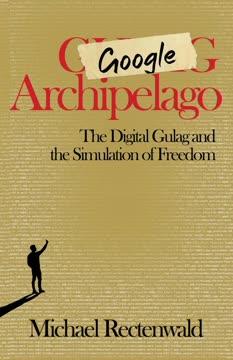
Within the Google Archipelago, leftist authoritarian totalitarians use Maoist Cultural Revolutionary tactics including the contemporary, digital and corporal equivalents of struggle sessions and auto-critique, but more importantly, the Soviet Red and Great Terror methods of exile, banishment, deletion, and disappearance.
**Author:** Michael Rectenwald
**Estimated Reading Time:** 45 minutes
**What You'll Learn**
How the world's largest technology companies have constructed a new system of digital control that combines corporate monopoly power, leftist ideology, and totalitarian methods. You will understand the tactics used to enforce ideological conformity online, the academic and cultural forces that enable this system, and what it means for individual freedom in an age of algorithmic governance.
**Who This Book Is For**
Anyone who senses that something has gone wrong with the digital world but cannot quite articulate what it is. Professionals working inside technology companies who feel the pressure to conform. Citizens concerned about the concentration of power over information and expression. Readers who value free speech and want to understand the forces working against it.
Something strange has happened to the internet. What was once celebrated as a decentralized marketplace of ideas, a digital frontier where anyone could speak and be heard, has transformed into something far more controlled. The platforms that promised to connect us now moderate us. The companies that claimed to organize the world's information now decide what information we see. The tools that were supposed to liberate human creativity now channel it into approved directions. This transformation did not happen by accident. It was not simply the natural evolution of technology or the inevitable result of market forces. It represents the construction of something new: a system of digital governance that operates across national borders, beyond democratic accountability, and according to an ideology that few people fully understand. Michael Rectenwald calls this system the Google Archipelago. The name evokes the Gulag Archipelago, Aleksandr Solzhenitsyn's monumental exposé of the Soviet prison camp system. The comparison is deliberate and provocative. Rectenwald argues that the digital world now contains its own version of the camps: not physical prisons with barbed wire and guard towers, but virtual spaces of exile, banishment, and disappearance. People who violate the ideological norms of the digital platforms find themselves deplatformed, demonetized, delisted, and effectively erased from public life. This is not a metaphor. It is a description of actual practices carried out by actual companies with actual consequences for actual human beings. The problem that Rectenwald identifies goes deeper than the familiar complaints about political bias or content moderation. He argues that the major technology platforms have evolved into something that resembles governmental entities more than private businesses. They control the infrastructure of public discourse. They shape the boundaries of acceptable opinion. They enforce norms through sophisticated systems of surveillance and punishment. And they do all of this while insisting that they are merely neutral platforms providing a service. What makes this system particularly dangerous, in Rectenwald's view, is the ideology…
Continue reading in the MinuteRead app
Get the complete 30-minute summary of Google Archipelago
Get the complete summary in the appThe major technology platforms have become systems of governance, not just businesses. They control the digital public s
The power to deplatform is the power to exile. People who are banned from the major platforms lose their ability to part
Corporate leftism provides moral justification for censorship. It frames suppression of speech as protection of the vuln
Digital Maoism enforces ideological conformity through mob pressure and public shaming. Fear drives self-censorship.
Academic scholars of digital media have largely failed to understand the true dangers of the Google Archipelago.
The Chinese model of technological control is spreading. Social credit, predictive policing, and automated censorship ar
"Google Archipelago" is a strong fit if you want practical ideas around politics, cultural, education, especially themes like the major technology platforms have become systems of governance, not just businesses. they control the digital public s; the power to deplatform is the power to exile. people who are banned from the major platforms lose their ability to part. The MinuteRead summary distills these concepts into a focused read, whether you're deciding whether to buy the book or applying its lessons at work.
Michael Rectenwald is a retired academic and author known for his critical views on Big Tech and digital capitalism. His book "The Google Archipelago" explores the potential dangers of technology companies assuming governmental roles and the rise of corporate socialism. Rectenwald's background in academia informs his analysis of social media algorithms, AI, and their impact on society. He is particularly concerned with the influence of progressive ideologies in tech companies and their effect on…
View all summaries by Michael RectenwaldContinue Reading
Access the complete 30-minute summary and thousands more nonfiction books in the MinuteRead app.

Continue reading the complete summary in the MinuteRead app.