MinuteRead
30 min
Book summary
by Lawrence Weinstein
Premium summary · Opens in the app · 30 min read
Some questions seem impossible to answer. How many gallons of gasoline do Americans burn every day? How many cells are in your body? How much land would we need to cover with solar panels to power the entire country? What are the odds you just inhaled a molecule from Julius Caesar's dying breath?
**Author:** Lawrence Weinstein
**Estimated Reading Time:** 45 minutes
**What You'll Learn:**
- How to estimate the answer to almost any question using nothing but common sense and basic arithmetic - Why being approximately right beats being precisely wrong - How to break down impossible problems into manageable pieces - How to use scientific notation to tame enormous and tiny numbers - How to apply estimation skills to energy, transportation, the environment, and everyday life
**Who This Book Is For:**
Anyone who has ever been stumped by a question like "How many piano tuners are in Chicago?" or "How much energy does a car use compared to a person?" This book is for curious minds who want to think more clearly about the world, make better decisions, and develop a practical superpower: the ability to estimate anything.
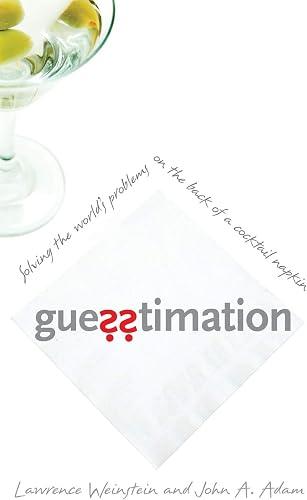
Some questions seem impossible to answer. How many gallons of gasoline do Americans burn every day? How many cells are in your body? How much land would we need to cover with solar panels to power the entire country? What are the odds you just inhaled a molecule from Julius Caesar's dying breath? Most people encounter questions like these and immediately give up. They assume that without access to precise data, without a calculator, without the ability to look something up, they cannot possibly arrive at a meaningful answer. This assumption is wrong. The truth is that you already possess everything you need to answer these questions with surprising accuracy. You know how many people live in the United States. You have a rough sense of how often you fill up your gas tank. You know how big your body is compared to a cell. You know the Earth is large and the atmosphere is thin. These everyday observations, combined with a few simple techniques, are enough to estimate answers to an astonishing range of questions. Lawrence Weinstein wrote Guesstimation to teach a skill that physicists, engineers, and scientists use constantly but rarely explain: the art of approximate reasoning. In physics, the ability to estimate is not a party trick. It is a fundamental tool for understanding whether an idea makes sense, whether an experiment is feasible, and whether a result is plausible. Before building a billion-dollar particle accelerator, physicists estimate what they expect to find. Before launching a satellite, engineers estimate the forces it will experience. Estimation is how experts check their thinking. The problem is that most of us were taught in school that getting the exact right answer is the only thing that matters. We learned to fear being wrong. We learned that a wrong answer is a failure. This mindset is crippling. In the real world, we rarely need exact…
Continue reading in the MinuteRead app
Get the complete 30-minute summary of Guesstimation
Get the complete summary in the appBreak big problems into smaller pieces, estimate each piece, and multiply.
Aim to be approximately right, not precisely wrong.
The exponent is the most important part of any number.
Use scientific notation to simplify calculations with large and small numbers.
A human body runs on about 100 watts.
A car uses about 15 times more energy than the person driving it.
"Guesstimation" is a strong fit if you want practical ideas around mathematics, science, physics, especially themes like break big problems into smaller pieces, estimate each piece, and multiply; aim to be approximately right, not precisely wrong. The MinuteRead summary distills these concepts into a focused read, whether you're deciding whether to buy the book or applying its lessons at work.
Motivated to help readers with "If you can't estimate the answer, Lawrence Weinstein wrote “Guesstimation” to package those ideas for a fast, focused read. In “Guesstimation”, Lawrence Weinstein focuses on "If you can't estimate the answer. Through “Guesstimation”, Lawrence Weinstein distills the core ideas on mathematics into lessons readers can absorb in a single short sitting. Readers turn to this work when they want Lawrence Weinstein's perspective on the subject without working through the …
Continue Reading
Access the complete 30-minute summary and thousands more nonfiction books in the MinuteRead app.

Continue reading the complete summary in the MinuteRead app.